


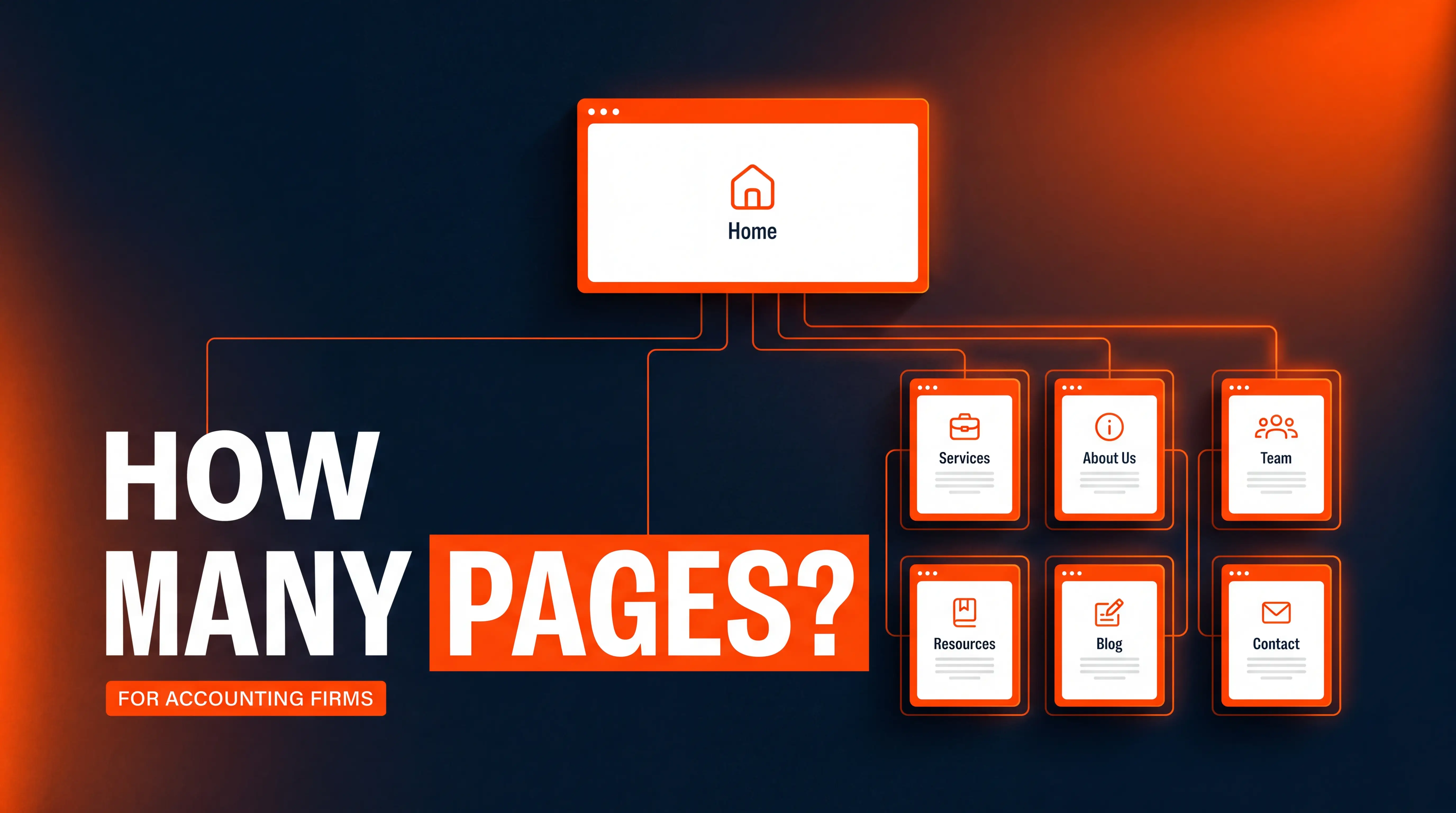
A small accounting firm website needs 7 to 12 pages in 2026: five core pages (Home, About, Services, Contact, and a Privacy Policy), a blog, and a handful of dedicated service or location pages. Most firms do great starting with 5 to 10 well-built pages, then adding more only when a new service or city genuinely needs its own page. Research on business sites in 2026 points to the same sweet spot, roughly 5 to 15 pages, with a hard emphasis on quality over quantity. The number is not the point. Pages that each earn their spot are.
I have rebuilt a lot of firm websites, and the biggest mistake I see is not too few pages. It is too many thin ones. A 40-page site where 30 pages get zero traffic is not authority. It is dead weight that slows your firm down. So instead of asking "how many pages should I have," ask a better question: "which pages help me get found, land the client, and keep them?" That question maps cleanly onto our Convert Smart Growth System, and it is how we will decide your page count below.
The 5 Core Pages Every Accounting Firm Website Needs
Before we talk about scaling up, nail the foundation. These five pages are the essential structure of any accounting firm website, and a surprising number of firms still get them wrong.
Home page. This is your handshake and your first impression. In the first screen a visitor should know who you help, what you do, and what to do next. That means a clear headline (not "Welcome to Our Firm"), one primary call to action like "Book a Free Consultation," and a few trust signals such as a client logo strip or a star rating. Your home page is a router, not a novel. Its job is to send the right visitor to the right service page.
About page. People hire accountants they trust with their money, so this page carries more weight than most owners think. Introduce the team with real photos, credentials (CPA, EA, QuickBooks ProAdvisor), and a short story about who you serve best. This is where a nervous prospective client decides you are a safe pair of hands, and it is a big part of the first impression your online presence makes.
Services page. At minimum you need one clear services overview. This is the spine of your site and, as I will explain next, the place where extra pages pay off the most.
Contact page. Make it easy to reach you. Put your contact information front and center: phone, email, a short contact form, an embedded map, and office hours. Keep the form fields lean. Every extra required field drops your conversion rate, so ask for name, email, phone, and a one-line "what do you need help with." You can qualify harder on the call.
Privacy Policy. Boring, but required. It protects you legally, it is a trust signal, and search engines treat these trust pages as a small quality cue. You can add an Accessibility statement here too if you serve regulated clients.
Pro tip: before you add a sixth page, make sure these five convert. A tight five-page site that turns 4 percent of visitors into calls beats a sprawling twenty-page site that turns 0.8 percent. If you are unsure where you stand, our breakdown of a realistic website conversion rate for an accounting firm gives you a benchmark to aim at.
Get Found: The Pages That Win Search and AI Visibility
The first stage of the Convert Smart Growth System is Get Found. This is where a few strategic pages do the heavy lifting for SEO and, increasingly, for AI answers in Google's AI Overviews and tools like ChatGPT and Perplexity. Here is where firms should spend their extra page budget.
Individual service pages. One overview page cannot rank for tax preparation, bookkeeping, payroll, and CFO advisory all at once. Search engines reward a dedicated page for each buyer-intent service, because each one targets its own keyword and answers its own question. A firm offering four services realistically wants four service pages. This is the single highest-return way to add pages, and it is why detailed service pages that turn CPA traffic into booked consultations outperform a single crowded list.
Location pages. If you serve more than one city or want to rank for "accountant near me" style searches, a page per key location helps you show up in local results. Do not spin up 50 near-identical city pages. That is thin content and it backfires. Build a genuine page for each real service area with local proof, directions, and area-specific detail. Pair this with a well-optimized Google Business Profile and you cover local search properly, which we unpack in our guide to local SEO strategies for accountants.
A blog or resource hub. This is one page that quietly becomes many. A blog lets you answer the real questions clients type into Google and AI assistants, and content marketing is how you build topical authority over time. You do not need hundreds of posts to start. If you are wondering about volume, we did the math on how many blog posts a small business needs to start ranking. The short version: consistency beats a one-time content dump.
Add these Get Found pages and a five-page site quickly and sensibly grows into a nine or ten-page site, without a scrap of filler.
Land the Client: Conversion Pages That Turn Visitors Into Calls
Traffic is not the goal. Booked calls are. The second stage, Land the Client, is about the pages that convert an interested website visitor into a scheduled consultation. Getting found only matters if the visitor then converts, and this is exactly why so many firms ask why their website is not getting leads despite decent traffic.
Dedicated landing pages for campaigns. If you run Google Ads or a seasonal tax promotion, do not send that paid traffic to your home page. Build a focused landing page with one offer, one message, and one call to action. Message match between the ad and the page is what protects your conversion rate and your ad budget. Our teardown of tax season landing pages that actually convert shows the copy and offer structure that works.
A booking page. Reducing friction between interest and appointment is one of the fastest wins for lead generation. An embedded scheduler on its own page removes the back-and-forth email tag. If you are on the fence about it, here is the case for adding online booking to your service business website.
A pricing or how-we-work page. Prospective clients self-qualify when you are transparent about process and price ranges. A clear value proposition on this page filters out tire-kickers before they eat your calendar and warms up serious buyers. It is not for every firm, but when it fits, it converts.
Notice that none of these are padding. Each one exists to move a specific visitor one step closer to becoming a client. That is the test for every page you add.
Retain and Grow: The Quiet Pages That Keep Clients
The third stage, Retain and Grow, is the one almost every firm forgets to design for, because they treat the website as a one-time lead machine instead of a client hub. A few small pages here protect your revenue and unlock referrals.
A client portal or login link gives existing clients a home base to upload documents and check status, which cuts down on email and makes your firm feel modern. A testimonials or case studies page turns happy clients into your best salespeople, and it doubles as powerful trust content for prospective clients. An FAQ or resources page answers the repetitive questions that otherwise clog your inbox, and it feeds the AI answer engines that now summarize the web. And a simple newsletter or updates page keeps you in front of your ideal clients between tax seasons, which is where year-round revenue hides.
These retention pages are cheap to build and they compound. A firm that leans only on new leads is running uphill, something we cover in the hidden cost of relying only on referrals. Retention pages help you grow the clients you already fought to win.
So What's the Right Number for Your Firm?
Here is a simple way to land on your page count. Start with the 5 core pages. Add one service page for each buyer-intent service you sell. Add one location page for each real service area. Add a blog. Add the one or two conversion pages your sales process actually needs, plus a testimonials page. For a typical small business accounting firm, that math lands between 8 and 14 pages. A brand-new one-person practice can launch beautifully on 5 to 7 and grow from there.
Resist the urge to inflate the number. Every page you publish is a page you have to maintain, keep accurate, and keep fast on mobile devices. Thin, redundant, or outdated pages drag down your whole website's quality in Google's eyes and confuse visitors. If a page does not help you get found, land a client, or retain one, it does not belong on your site. When you frame it that way, page count stops being a guessing game and becomes a strategy. If you want a second set of eyes on which pages your firm truly needs, that is exactly the kind of thing we map out on a growth call.
Frequently Asked Questions
Is a one-page website enough for an accountant?
For a brand-new solo practice testing the waters, a strong one-page website with clear sections and a booking link can work for a few months. But it caps your SEO hard, because you cannot rank a single page for multiple services or locations. Treat one-page as a starting line, not a finish line, and plan to expand into core and service pages as soon as you have the bandwidth.
Do more pages help SEO?
More quality pages help, because each well-built page can rank for its own keywords and answer its own question. More thin or duplicate pages hurt, because they dilute your site's quality signals and can trigger a search engine to see your content as low value. The winning move is depth: fewer pages, each genuinely useful, each targeting real buyer-intent search terms.
How many service pages should an accounting firm have?
One per distinct, buyer-intent service you want to be found for. If you sell tax prep, bookkeeping, payroll, and advisory, that is four service pages, each with its own copy, keyword focus, and call to action. Do not lump them onto one page if you want to rank for each service.
Should each location have its own page? Yes, if you genuinely serve multiple areas and each page has unique, useful content. A real page per city with local proof and specifics helps you appear in near me and map searches. Avoid mass-producing near-identical city pages, which reads as thin content and can hurt you.
Build the Right Pages, Not Just More Pages
The honest answer to how many pages your accounting firm website needs is: as many as it takes to get found, land the client, and retain and grow, and not one page more. For most small firms that is somewhere between 8 and 14, built deliberately across those three stages. Nail your five core pages, add strategic service and location pages for search, add the conversion pages your sales process needs, and support it all with retention pages that keep clients close.
If you would rather not guess, we can audit your current website, map it to the Convert Smart Growth System, and tell you exactly which pages to build, cut, or combine. Book a Free Growth Call and let's design a site that earns its page count.
Related Posts Worth Reading
- 1. The Digital Front Office Blueprint: 12 Service Pages That Turn CPA Website Traffic Into Booked Consultations
- 2. Why Is My Accounting Firm Website Not Getting Leads? 7 Fixable Reasons
- 3. What's a Realistic Website Conversion Rate for an Accounting Firm in 2026?
- 4. Should I Add Online Booking to My Service Business Website in 2026?