


.png)
Here is a hard truth most CPA firms do not want to sit with.
You could be getting 2,000 visitors a month to your accounting website. But if your service pages are thin, vague, or disconnected from each other, most of those visitors leave without ever clicking "Schedule a Call." They do not ghost you because they do not need your help. They ghost you because your website did not give them a reason to stay.
The global average website conversion rate sits around 2.35% across all industries in 2026. But here is the part that stings: professional services like accounting and consulting average between 4% and 6%, and top performers in advisory services hit 6% to 10%. What is the gap between where your website is and where it could be? Those booked consultations are sitting on the table.
This is not about having a "pretty website." It is about building what we call a digital front office, a connected system where your traffic, your service pages, and your conversion path all work together. And right now, with Generative Engine Optimization 2026 reshaping how people find accountants through AI tools like ChatGPT, Perplexity, and Google's AI Overviews, this system matters more than ever.
Let's get into it.
Why Most CPA Websites Are Just Digital Brochures (And What That's Costing You)
Think about the last time you visited a generic accounting website. You probably saw a homepage with "We help individuals and businesses with tax, accounting, and financial planning." Then a services dropdown. Then a wall of text. Then, a contact form is buried at the bottom of the page.
That is not a sales machine. That is a pamphlet.
The problem is not the firm. The problem is structure. Most CPA websites are built as collections of disconnected pages, each one doing its own thing, with no system connecting traffic to trust to conversion.
In 2026, accounting websites need strong local signals, clear service pages, a clean site structure, and trust-building content that helps prospects feel confident. If these elements are absent or only partially present, even the most effective marketing efforts will result in insufficient leads.
The importance of these elements is increasing. Search behavior has changed. AI tools like Google Gemini, Perplexity, and Microsoft Copilot now scan websites and generate concise summaries for users, often pulling from well-structured pages with schema markup and direct answers. If your service pages do not speak clearly to those systems, you are invisible to a growing chunk of your target audience.
That's the whole premise behind accounting firm service pages that convert. They're not just informational. They're conversational, empathetic, and structured to move someone from "I have this problem" to "I want to book a call with these people."
The Connected System That Changes Everything
Most firms treat their website like a brochure. We treat it like a sales team.
Here is the difference:
Generic web presence: Homepage > Services list > Contact Us
Connected digital front office: Targeted traffic (SEO + GEO) > Specific service page (structured, trust-building) > Low-friction CTA > Automated follow-up > Booked consultation
Every piece links to the next. When one part is missing, the whole system underperforms.
The 12 service pages we are about to cover are not just page ideas. Each one plays a specific role in this system. Some capture awareness while consistently improving customer retention. Some build trust. Some close the conversion. Together, they function like a front desk that never sleeps, never forgets to follow up, and consistently never misses a potential client.
Generative Engine Optimization: Why Your Service Pages Need to Be AI-Ready
Before we get into the 12 pages, let's talk about the environment your website is operating in right now.
Somebody who needs a CPA for their startup might not open Google and type in keywords anymore. They might ask ChatGPT, "What should I look for in a CPA for a SaaS company to ensure consistent customer support?" or prompt Perplexity to find the best accounting firms for small businesses in their city. These AI tools pull from websites that are structured to answer questions clearly, use relevant entities, and demonstrate expertise.
Generative Engine Optimization 2026 is the practice of structuring your content and service pages so that AI-powered search tools can understand, trust, and cite your website as a reliable source. The best agencies and websites in 2026 concentrate on improving entities, using structured data, creating trustworthy content, and measuring performance to help AI find and use their information.
For your CPA service pages, this means:
- Each page answers a specific question your ideal client is already asking
- Pages use structured data, schema markup, and clear formatting
- The content demonstrates real expertise, not just service descriptions
- Internal linking connects relevant pages, so AI systems see topical depth
- Each page has a clear, single conversion action
Keep this in mind as we walk through the 12 pages. Every single one should be built with both human readers and AI retrieval systems in mind.
The 12 Service Pages That Make Up a High-Converting CPA Digital Front Office
1. Tax Planning for Business Owners
This is not your generic "tax services" page. This one speaks directly to the business owner who is already running a company and wants to pay less in taxes, legally, with a plan. It should explain what proactive tax planning looks like at your firm, who it is right for, and what the process looks like from first call to year-end review.
Conversion element: A simple quiz or intake form: "How much could you save with proactive tax planning?"
2. Startup and SaaS Accounting Services
SaaS companies and startups have unique financial needs, from equity compensation to revenue recognition to runway management. A dedicated page here signals to that audience that you understand their world. Generic accounting pages lose these clients to firms that consistently speak their language.
Conversion element: A free "Financial Readiness Checklist for Startups" as a lead magnet download.
3. Small Business Bookkeeping
This page targets the local small business owner who is drowning in receipts and has no idea if they are actually profitable. It needs to be written in plain language, with specifics about what is included, how often, and what the first 30 days look like.
Conversion element: Pricing range or package comparison table.
4. CFO Advisory Services
This one is for growing businesses that need CFO-level thinking but cannot afford a full-time hire to improve their customer engagement. The page should clarify the difference between a bookkeeper, a controller, and a fractional CFO, because most business owners are confused by this. When you clarify it, you position yourself as the expert.
Conversion element: "Schedule a 20-minute CFO strategy call."
5. Tax Preparation for Individuals and Families
Yes, you need this page even if your primary focus is business clients. Spouses, business partners, and referrals often land here first. This page should be warm, reassuring, and specific about the process, especially for clients with complex situations like RSUs, rental properties, or foreign income.
Conversion element: Seasonal urgency: "Schedule before [date] to secure your spot."
6. IRS Representation and Tax Relief
This page captures high-intent, high-stress visitors, people who already have a tax problem and are looking for someone to fix it. The writing here needs to be calm and authoritative. No fear-mongering. Just: "Here is the problem, here is how we handle it, and here is how you get started."
This is one of the highest-converting categories for accounting firm service pages that convert because the visitor has urgent, high-stakes intent.
7. Accounting for Real Estate Investors
Real estate investors are a specific, valuable client segment with unique needs: depreciation, 1031 exchanges, cost segregation, and entity structuring. A dedicated page for this niche ranks well and converts well because it speaks directly to what this audience is searching for.
Conversion element: A free guide, "The Real Estate Investor's Tax Strategy Checklist," to maximize your ROI.
8. Payroll Services
Payroll is often a gateway service. A business owner who trusts you with payroll is very likely to hand you their books and their tax returns. This page should address the pain points directly: "Are you tired of running payroll manually every two weeks?"
Conversion element: "Get a custom payroll quote in 24 hours."
9. Business Formation and Entity Structuring
This page targets brand-new business owners who are in the process of starting their company and deciding between LLC, S-Corp, and C-Corp. It positions your firm at the very beginning of the client relationship, ensuring a consistent ROI before they even have revenue.
Conversion element: "Not sure which entity is right for you? Let's talk for 15 minutes."
10. Accounting for E-Commerce and Amazon Sellers
E-commerce is exploding, and so is the complexity that comes with it: multi-state sales tax, inventory accounting, marketplace fees, and platform integrations. Very few CPA pages target this niche well. If you serve this audience, this page alone can be a significant traffic and conversion driver.
Conversion element: "We work with Shopify, Amazon, and WooCommerce sellers. Schedule a free consultation."
11. Financial Reporting and Audit Support
This page serves growing businesses that need clean financial statements for investors, lenders, or board members. It is less about individual clients and more about companies at a growth inflection point. The language here should reflect that: professional, specific, and consistently outcome-focused.
Conversion element: "Need investor-ready financials? Let's build a timeline."
12. Client Onboarding and What to Expect Page
This one is underrated, and almost nobody does it. A dedicated "What to Expect as a New Client" page removes the friction of the unknown. It answers questions like What happens after I schedule a call? How do you handle my data to ensure customer privacy? What does the first month look like?
Giving prospects a clear view of what happens after they submit a form or schedule a call directly improves conversion rates and reduces the drop-off between inquiry and signed engagement.
Conversion element: "Ready to get started and see a positive ROI? Here is exactly what happens next."
How to Build Each Page So It Actually Converts
A service page that does not convert is just content taking up server space. Here is a simple framework for each of the 12 pages above:
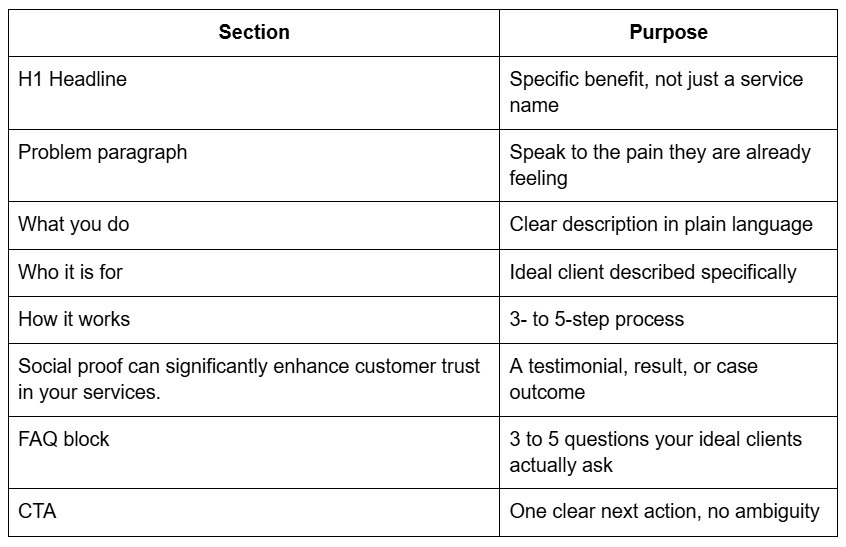
That FAQ block at the bottom is especially important for Generative Engine Optimization because AI engines prioritize content that provides direct answers, and optimizing FAQ pages with structured data increases the chances of being featured as an authoritative source.
What Connects These Pages Into a System (This Is the Part Most Firms Miss)
Here's where many CPA websites fall short, even when they have good individual pages. The pages exist, but they don't connect.
A visitor lands on your bookkeeping page from a Google search. They read it. They're interested but not quite ready to book. There's no follow-up sequence. No lead magnet. No way for you to stay in front of them. They will leave and forget your firm's name by tomorrow morning.
The firms that win are the ones that treat their website as a connected system, not a collection of separate pages. Your traffic source feeds into your service pages, which feed into a CTA, which feeds into a follow-up sequence that nurtures the lead until they're ready.
That's the difference between a generic web presence and a digital front office. Accounting firm service pages that convert are not standalone pages. They're part of a funnel.
The connected system looks like this:
Traffic (SEO, Google Ads, referrals) leads to a targeted service page with clear messaging, which leads to a low-friction CTA (free call, lead magnet, tax checklist download), which flows into email or SMS automation that follows up, which leads to a booked consultation.
Every stage matters. If any one part is weak, the whole thing leaks.
A Note on Webflow and Why Platform Matters for This System
If you are building or rebuilding your CPA website, the platform you choose affects everything we just covered. Webflow gives you native control over schema markup, page structure, CMS-powered service pages, and performance optimization, all without being locked into a template that fights you at every turn.
We build CPA and accounting firm websites in Webflow specifically because the connected system we described, where traffic, service pages, conversion paths, and retention all link together, is much easier to execute in a platform that gives you full structural control.
A slow, unstructured website built on a cheap template is not just a branding problem. It is a conversion problem, and increasingly, because AI tools evaluate content quality, page speed, and structure before deciding whether to cite your website.
What to Do This Week
You do not have to rebuild your entire website overnight. Start here:
- Audit your current service pages. Open each one. Does it have a headline that speaks to a specific pain? Does it have a clear single CTA? Does it have any social proof? Does it have an FAQ section to address common customer inquiries?
- Pick the two service pages most likely to drive new consultations. These are usually Tax Planning and your highest-niche service (real estate, SaaS, e-commerce). Rewrite those first.
- Add schema markup to improve customer visibility online. If your website does not have structured data on your service pages, that is the single fastest improvement you can make for both SEO and AI search visibility.
- Build the internal links. Go to each service page and add one to two contextual links to related pages on your site.
- Test your CTA. Change "Contact Us" to something specific: "Schedule your free 20-minute consultation" or "See if we are the right fit."
Conclusion: Your Website Should Work as Hard as You Do
Here is the thing. You became a CPA because you are good at numbers and you genuinely help people. But if your website is not reflecting that, if it is just a digital brochure with a few service descriptions and a buried contact form, you are doing yourself a disservice.
This blueprint's 12 service pages are not merely checklists; their design consistently drives customer engagement. They are a connected system. Traffic comes in through targeted SEO and AI-driven search. Specific service pages build trust and answer the right questions. A clear conversion path turns that trust into a scheduled call. And automated follow-up makes sure that the call actually happens.
That is the difference between a generic web presence and a digital front office.
If you want help building this system on Webflow, with the structure, the copy strategy, the SEO, and the conversion architecture all built in, we would love to talk. Schedule your FREE discovery call right now → https://www.progeektech.com/1on1-strategy and let's map out what your CPA website's front office could look like.