


.jpeg)
You know you need SEO. Someone likely told you it's important. So you Google it, ask around, or get a few proposals, and suddenly you’re looking at quotes from $300/month to $10,000/month.
For the same stuff.
It’s confusing. It has a scam feel to it. And to be fair? That confusion stops a lot of good businesses from investing in something that could really grow their revenue. So let's cut to the chase. In this post, we’ll break down what SEO actually costs in 2025 and 2026, what causes those price differences, and how you can establish a realistic budget for your specific situation.
How Much Does SEO Cost?
Short answer: Most businesses spend between $500 and $10,000 per month on SEO in 2026, with the average small business paying $1,000 to $2,500 monthly. What you need depends on three things: your business type, your competition, and how fast you want results. Here are the real 2026 monthly ranges by business type:
- Local small business: $500–$2,000/month
- Professional services (accountants, lawyers, dentists): $1,000–$3,500/month
- Multi-location or regional brand: $2,000–$5,000/month
- National or ecommerce: $2,500–$7,500/month
- SaaS or B2B tech: $3,000–$10,000/month
Skip to the SEO Cost Calculator below to run your own numbers, or keep reading for what causes the price differences and what you actually get at each level.
How Much Does SEO Cost for a Small Business?
Small businesses typically pay $500 to $2,500 per month for SEO in 2026. At the lower end ($500–$1,000), you get basic local SEO, Google Business Profile optimization, and maybe 1–2 blog posts a month. At the higher end ($1,500–$2,500), you get technical fixes, content clusters, active link building, and monthly reporting that ties back to actual leads.
The math that matters more than the monthly cost: if one new customer is worth $2,000 to your business and one new client per month covers your entire SEO spend, you're profitable from month one. Think in terms of client lifetime value, not monthly line item.
How Much Should My Company Spend on SEO?
Simple formula: allocate 5–10% of revenue to marketing, then 30–50% of that marketing budget to SEO. For a $500,000/year business, that's $625–$2,000/month on SEO. For a $2M business, closer to $2,500–$5,000/month. Use the calculator below to plug in your actual revenue, close rate, and average customer value — it'll tell you the recommended budget and how long it takes to pay for itself.
Why SEO pricing seems so random (and why it isn't)
So here’s the deal about SEO: it’s not a service. It’s a system with many moving parts, technical fixes, content creation, link building, local optimization, and ongoing monitoring. When they give you a quote, they are telling you how many of those parts they are going to work on and how aggressively.
Hence, the spread is so wide.
SE Ranking’s 2025 agency survey found that the most common monthly pricing ranges are on the low end, from $500 to $1,000, with 64% of agencies charging under $1,000 per month. But the average business spends around $2,500 per month when you consider real, results-driving campaigns, according to WebFX.
Which number is right for you?
It comes down to three things:
- The size of your business,
- Your industry competition, and
- Your goals.
Why Search Engine Optimization Is So Expensive
Before you can build a budget, you have to know what you’re actually paying for. Here are the key factors that move the needle on price. If you want the short benchmark answer first, we cover it in how much a small business should spend on SEO.
1. Size of Business & Website Complexity
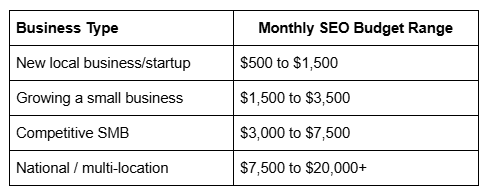
A local accounting firm with a 10-page website has very different needs than a SaaS company with hundreds of landing pages, blog posts, and product pages. Bigger sites mean more hours, more strategy, and more ongoing maintenance."
Here is a rough breakdown by business size, based on current market data:
2. How Competitive is Your Industry?
If you are a general contractor in a small town, you can rank on the first page of Google with a small investment. If you’re a SaaS company targeting keywords like “project management software,” you’re competing with companies that have been doing SEO for a decade and have massive content libraries.
More competition equals more work, which equals more cost.
This is where SEO costs are typically higher, like in sectors such as legal services, insurance, accounting, and SaaS, competitive spaces where everyone is fighting for the same keywords.
3. Local Reach vs. National Reach vs. Global Reach
The cheapest kind of SEO is local SEO, which is the process of ranking in your city or region. You're going after a smaller geography with less competition. National campaigns need more content, more backlinks, and more resources.
Local SEO usually costs between $300 and $1,500 per month. National campaigns typically begin at about $2,500 and above.
4. What You Actually Get
Not all SEO packages are created equal. A low-cost provider would do keyword tracking and some meta tag updates. A full-service agency creates content clusters, gets backlinks from high-authority websites, solves technical issues, and measures how all of it fits into your revenue.
Ask what’s included in the price. A $500/month package doing one blog post and some basic reporting is very different from a $2,500/month package with weekly content, technical audits, and active link building.
The 3 Common SEO Pricing Models
Retainer (Monthly)
This is the most frequent model. You pay a fixed price monthly, and the agency handles a list of SEO tasks in progress. This is good if you want consistent results over a period of time, which is actually how SEO works.
This is what most companies do. Monthly retainers enable you to build momentum and stay competitive without having to renegotiate a new agreement every few months.
Consulting Hourly
If you’ve got an internal team to do the execution but need strategic direction, hourly consulting might be a fit. The most common SEO hourly rate is $100-$150, and 25% of SEO pros charge that rate, according to Ahrefs. Rates vary elsewhere from $75 to $200 an hour, depending on experience and specialty.
Project-oriented
Great for one-off needs such as a technical SEO audit, a content strategy roadmap, or a keyword research project. Depending on the scope, the cost of a project generally runs between $500 and $5,000.
The Real Danger
This is where many small businesses go up in smoke.
It’s tempting when you see an overseas provider offering $150/month or even $500/month. But here’s the thing: The average SEO specialist in the US makes over $70,000 per year, according to Glassdoor. If somebody is charging you $150/month, the math doesn’t work. You're either getting very little or you're using tactics that can get your site penalized by Google.
And recovering from a Google penalty costs far more than good SEO. Some companies spend 3 to 5 times the price of prevention just to clean up the damage of bad link schemes or keyword stuffing.
The wrong question is not “what’s the cheapest SEO I can get?” It’s “what’s the minimum investment that’s actually going to move the needle for my business?”
A Basic Formula for an SEO Budget
Here’s an easy way to think about your budget:
- Step 1: How much do you make per year?
- Step 2: Set aside 5 to 10% of that for your total marketing budget.
- Step 3: If organic search is a priority channel for you, dedicate 30 to 50% of your marketing budget to SEO.
If your business earns $500,000/year in revenue:
- Marketing budget: $25,000-$50,000
- SEO budget: $7,500–$25,000/year or $625-$2,000 per month
This gives you a starting point. Then adjust up or down depending on your competition and goals.
What You Really Get from a Good Search Engine Optimization Price
Say you’re putting in $2,500 to $3,500 a month with a quality agency. Here’s what that should look like:
- Technical SEO audit and fixes: Page speed, mobile-friendliness, crawling, and indexing issues
- Keyword research and strategy: Finding the terms buyers actually look for
- Content Creation: Service pages, blog posts, landing pages that convert and rank
- On-page Optimization: Title tags, Headers, Internal links, Schema markup
- Link building: Getting backlinks from other reputable sites
- Monthly reports: Clear data on rankings, traffic, leads, and what is working
Most businesses start seeing meaningful movement within 4 to 6 months at this level. It can take 6-12 months to see clear ROI, but 91% of businesses in Conductor’s 2025 State of SEO report said SEO positively impacted their website performance and marketing goals.
SEO Cost Calculator: How Much Should You Budget for SEO?
SEO pricing ranges from $300 to $10,000 a month, and most business owners have no idea where they should land in that range. Here is how to think about it — and a tool to run your own numbers.
Move the sliders to match your business. You'll get a recommended monthly SEO budget, a realistic revenue projection, and the month your investment pays for itself.
How this works: Budget guidance uses the industry benchmark of 5–10% of annual revenue to marketing with 30–50% of that to SEO, bounded by typical spend ranges for your business type and adjusted for competition. Revenue projections apply your inputs through a standard search funnel (searches → clicks → leads → customers) and are ramped over 12 months, because SEO builds rather than switches on. These are planning estimates, not guarantees — actual results depend on your market, site and execution.
Red Flags To Be Aware Of When Hiring an SEO Agency
For the full vetting playbook, see our guide to choosing an SEO agency: 12 questions to ask + 7 red flags.
Not every agency that quotes you is the real thing. Beware of:
- Guaranteed rankings: There is no guarantee of any specific ranking on Google. Google’s own algorithm
- No clear deliverables: If they can’t tell you exactly what they’re going to do each month, that’s a problem.
- No transparency: A good agency shows its work. Locked in long contracts. You should be able to see what's going on.
- Suspiciously low prices: As mentioned above, if the numbers don’t add up on their end, something’s up.
- No case studies or references: Demand evidence. Good agencies have results to prove it.
Frequently Asked Questions
What should a small business expect to pay monthly for SEO?
The majority of small businesses see results at $1,000-$2,500 a month. In a competitive market, most agencies can’t do enough work to get the needle below $500/month.
Is SEO Worth It For A New Business?
Yeah, but you need to have real expectations. SEO is a long-term investment. It takes 4-6 months for most businesses to see real results, and by month 12, the ROI gets stronger. If you need leads now, combine SEO and paid advertising while the organic work is gaining momentum.
What is the difference between cheap SEO and good SEO?
Cheap SEO usually means fewer hours, lower-quality content, and even dangerous tactics such as buying backlinks. Quality SEO is a real strategy, consistent execution, and content that actually answers what your customers are looking for.
How to know if your SEO agency is doing a good job?
Look at organic traffic trends, keyword ranking improvements, and most importantly, leads or conversions coming from organic search. A good agency will send you monthly reports that clearly tie their work to your business results. If you don’t see traffic growth in 4-6 months, have an honest conversation about what is working and what isn’t.
Conclusion: Don't Guess, Plan
Businesses don't fail at SEO because they spend too little or spend too much. It’s spending without a plan.”
When you know what goes into the price of search engine optimization, what makes the cost go up or down, and what to expect at different price points, you're not guessing. You’re making a business decision supported by real data. The companies that win at SEO aren’t always the ones with the biggest budgets. They invest consistently, work with people who know what they're doing, and give the strategy time to work.
If you’re a SaaS company, an accounting firm, or a local small business wondering where to start or have tried SEO before and didn’t see results, let’s talk about it. Schedule a free strategy call with the Progeektech team. We'll look at your current situation, your competition, and what a realistic SEO investment looks like for your business goals. No pressure, no vague promises, just an honest conversation about what it takes to grow.