


.png)
You have been doing blog posts. You changed your site. Maybe you even paid someone to “do SEO” for you for 6 months.
But your competitor, the business two miles away or in the same city, keeps showing up above you on Google. They’re taking the clients that you should be getting. And the annoying part? You don't know why.
Here’s what’s probably happening: They’re ranking for keywords you’ve never even considered targeting. Not because they're more clever. Not because they have a better company. But someone mapped out the keyword landscape and created content with a strategy.
And that's all this post is about. You will learn how to do a real SEO competitive gap analysis for CPA firms. You will learn how to find the exact search terms your competitors are monetizing and how to create content that will actually show up when your future clients are searching.
Why The Majority of CPA Firms Are Flying Blind With SEO
Let’s start with the real problem.
This is how most accounting firms do SEO: Someone in the firm thinks, “We should write about tax tips,” and then they write a blog post called “5 Tax Tips for Small Businesses.” Then nothing.” There is no traffic, leads, or ranking increase. And the conclusion they come to is that SEO doesn’t work for accountants.
But that’s not the issue. The problem is they never checked what their target clients are actually searching for, and more importantly, they never looked at what their competitors are already ranking for.
Over 90% of all web pages receive zero organic traffic from Google, according to Ahrefs. The content wasn't bad or anything. That's because the content wasn't built on real search demand.
And here’s the thing about the accounting space in particular… Your competitors have done some of the hard work for you. Every keyword they rank for is a data point. Each page that generates traffic is a map to what your future clients are looking for.
How different are their rankings from yours? This is your opportunity. And it is by doing a proper SEO competitive gap analysis for CPA firms that you find it.
What Exactly Is a Competitive Keyword Gap?
Before we dive into the system, let's make sure we're clear.
A keyword gap is any search term that your competitor ranks for but you do not. That's all there is to it.
But in that gap there are different types of opportunities worth watching:
- Keywords that your competitors are ranking for, but you aren't in the top 100 at all. These are the biggest holes.
- Weak keywords: Both of you appear, but you are on page 3 or below. You have some relevance here; you just need to build up the content.
- Untapped keywords: Terms that none of you rank for strongly but that have real search volume. These hidden gems are easier to find.
Once you map these out, you stop guessing and you start creating content that has a real chance of ranking.
Step 1: Identify Your True SEO Competitors (It's Not Who You Think)
Here’s a mistake a lot of CPA firms make. They think their SEO competitors are the same as their business competitors.
No.
Your SEO competitor is whomever is on page 1 when someone searches for services you offer.
That might be a local CPA. But it could also be an article from Forbes, a directory like Thumbtack, or a national accounting software company targeting your clients.
So let’s begin here. Open an incognito browser and type in five to ten terms your ideal clients would search for. CPA is a small business firm located in [your city]. “QuickBooks bookkeeping help for LLC” “How to pay less taxes as a freelancer" best accountant for real estate investors
Record who appears in the top five results for each.
After a few searches, patterns will begin to emerge. You'll see a couple of sites pop up repeatedly. These are your real SEO competitors; these are the domains you’ll analyze.
Step 2: Conduct The Real SEO Competitive Gap Analysis for CPA Firms
Now we get to the data.
You can do this well without spending thousands of dollars on tools. Here’s a simple setup:
Free choice: Google Search Console (for your data) + Ubersuggest free tier or Google’s own “People Also Search For” feature.
Paid and much faster: Ahrefs, Semrush, or Moz. These will all work. In fact, Semrush has a dedicated tool called “Keyword Gap” that makes the process almost foolproof.
Here’s how to do the analysis:
Step A: Input your domain in the tool and add two to three competitor domains side by side.
Step B is to run the keyword gap/content gap report. The tool will show you all the keywords that competitors rank for and you don’t.
Step C: Results Filtering. You want to concentrate on keywords with:
- Search volume per month between 100 and 2,000 (the sweet spot for a CPA firm, not too competitive)
- Keyword difficulty < 40 (more realistic to rank for)
- Explicit commercial or informational intent (someone looking for help, not just browsing)
Step D: Export list. Chances are you'll have hundreds of keywords. "Don't panic. You are going to order them out.
Semrush’s 2024 State of Search report says long-tail keywords (three or more words) make up roughly 70% of all searches. This is pure gold for CPA firms. Someone typing “CPA for real estate investor LLC in Austin” is a lot closer to hiring somebody than someone typing “accountant.”
Step 3: Organize the Gaps Into a Content Map
This is where most people mess up. They get the list of keywords and then they don’t know what to do with it.
The answer is easy: group by topic cluster, then prioritize.
A topic cluster is, in simple terms, a set of related keywords that you can cover with a single main page or a group of related pages. For a CPA firm, your clusters might look like this:
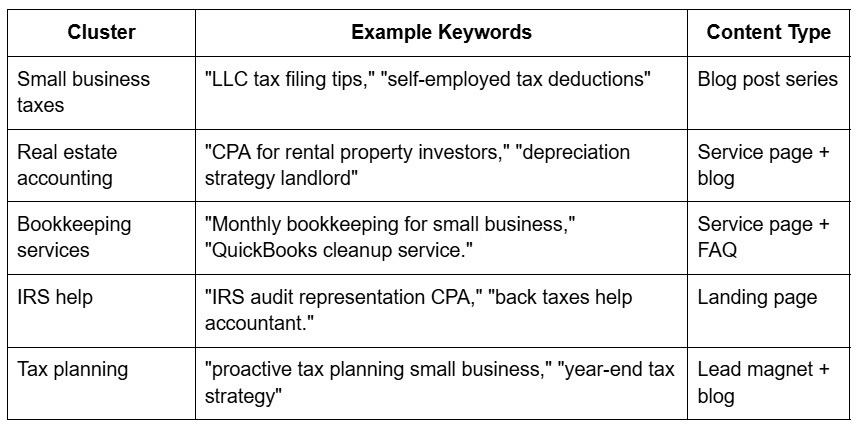
Once you map the gaps into clusters, you can see which ones have the most volume and the lowest competition. Start there.
This is the part of SEO competitive gap analysis for CPA firms that makes a spreadsheet a real growth plan.
Step 4: Build Content That Actually Wins the Gap
Knowing the keywords is only half the battle. The content has to be built to win.
Here's what separates the CPA firms that rank from the ones that don't:
Match search intent exactly. If someone searches "how to deduct home offices as a freelancer," they want a clear answer with steps. Not a page about your bookkeeping services. Write the content that answers the question first, then naturally tie in your credibility and CTA at the end.
Go deeper than the competitor. Open the top-ranking pages for your target keyword. Read them. Ask: What did they miss? What question would a real client still have after reading this? That's your angle. A BrightEdge study found that content depth and topic comprehensiveness are among the top factors in sustained first-page rankings.
Use the right structure. Google's algorithm is built around understanding what a page is about. Use your target keyword in the title tag, the H1, and at least one H2. Include related terms naturally. If you're writing about tax deductions for real estate investors, you should also be mentioning things like depreciation, cost segregation, passive income, rental property, Schedule E, and 1031 exchanges. These are the semantic signals that tell Google what your content really covers.
Write for the person, not the algorithm. This sounds obvious, but most CPA blog posts read like they were written for a search engine. Your clients have real problems: they're stressed about taxes, confused about payroll, and scared of audits. Speak to that. Use plain language. Be specific. A sentence like "If your S-corp has more than $50k in net profit, there's a good chance your current salary setup is costing you in self-employment taxes" is worth more than three paragraphs of generic advice.
Step 5: Track, Measure, and Close the Gap Over Time
This isn't a one-off job. The whole point of building an SEO competitive gap analysis into your marketing for CPA firms is that it is ongoing.
Here is an easy quarterly routine:
Month 1: Conduct the gap analysis, develop your content map, and publish a couple of items that address the highest priority gaps.
Month 2: See how your published content is ranking. Check which queries are starting to show up in Google Search Console. Optimize with real data.
Month 3: Conduct a gap analysis again. Look for competitor content. Update your map. Publish the next batch.
Every six months: See if your competitors have changed. Firms enter markets. Old ones get better in SEO. Ensure your analysis is up-to-date.
This is the type of consistent compounding approach that leads to real results. According to BrightEdge research, organic search accounts for more than 53% of all website traffic, more than any paid channel. The companies that see SEO as a system and not a one-time campaign are the companies that ultimately own their market.
What This Looks Like With Real Numbers
I'll paint a realistic picture for you so you can manage your expectations.
A CPA firm that is implementing this system from scratch can reasonably expect the following:
- First rankings in Google in 60 to 90 days for long-tail keywords with lower competition
- Page 1 rankings for 3 to 5 targeted terms in 4 to 6 months (assuming consistent publishing – 2 to 4 posts per month)
- In 6 to 9 months you will be getting real, inbound, organic leads. That means clients that found you on google
A compounding effect where each piece of content adds to your overall organic presence
These are real estimates based on consistent execution. Results depend on your existing domain authority, the competitive nature of your local market, and the quality of content built. The assumption here is that you are consistently publishing quality content, not once every three months.
The Tools You Need (And What They Actually Cost)
You don't have to spend a fortune. Here is a candid analysis:
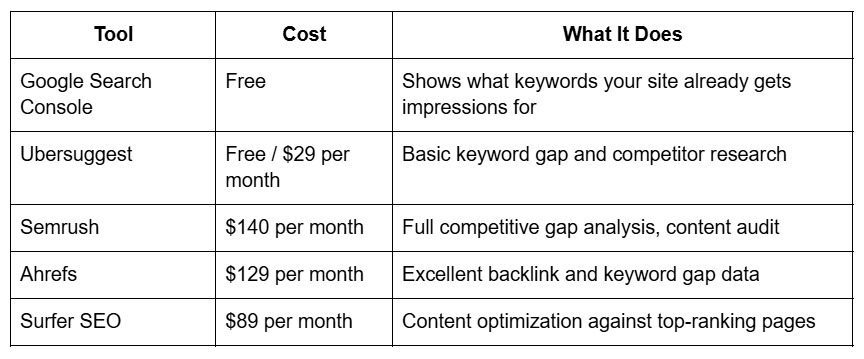
For most CPA firms just starting out, Ubersuggest at the free or low-cost tier, plus Google Search Console, will get you 70% of the way there. If you’re looking to go further and faster, Semrush or Ahrefs are worth the investment, particularly if you’re having an agency or consultant do the analysis for you.
Frequently Asked Questions
How does a keyword gap analysis differ from keyword research?
Regular keyword research starts from zero. You brainstorm topics and check volumes A keyword gap analysis begins with your competitors’ existing rankings, revealing the tried-and-true search terms that are already bringing traffic to their sites. It’s faster, more focused, and supported by real market intelligence rather than suppositions.
How often should a CPA firm do an SEO competitive gap analysis?
Cadence: Quarterly is recommended. Search landscapes evolve. Competitors create new content. New companies form. Google changes its algorithm. Running the analysis every 3 months ensures your content map is up to date and you are targeting gaps before they become too competitive.
Can I do this analysis myself, or should I hire an SEO agency?
You can get started yourself with free tools like Google Search Console and Ubersuggest for some basic gap data. But the paid tools like Semrush or Ahrefs speed things up and make things much more accurate. Most CPA firms want to do the initial setup themselves, then bring in an agency to scale execution and ongoing optimization.
What are the keywords CPA firms should be focusing on from the gap analysis?
Target long-tail keywords (three words or more) with 100 to 2,000 searches per month and keyword difficulty under 40. These terms attract highly specific, intent-driven searchers—people actively looking for accounting help—not just casual browsers. Also, they are more realistic to rank for without built-up domain authority.
Conclusion: Stop Publishing Content and Start Building a System
Here’s the thing: most CPA firms don’t need more content. They’ve got a strategy problem.
They post without looking at what clients are searching for. They write about what their competition already owns. Their measure of success is publication, not ranking.
A proper SEO competitive gap analysis for CPA firms flips the entire approach. You stop guessing and start creating content that actually has a shot at ranking, getting traffic, and turning that traffic into clients.
The companies that win at SEO aren’t creating more content than you are. They’re creating smarter content that fills real keyword gaps and answers real questions.
You have the system now to do the same.
Want to bypass the learning curve and have this done for you? Progeektech works with CPA firms and accounting practices to develop data-driven SEO systems that generate real, qualified leads.
Schedule your FREE discovery call right now → https://www.progeektech.com/1on1-strategy
Recommended Blog Posts
1. Why CPAs Are Losing Leads to Competitors in AI Search (And the 2026 GEO System That Fixes It)
2. Digital Marketing for Accountants: The 2026 Playbook to Fill Your Pipeline
3. The Niche Authority System for CPAs: Build Industry-Specific Pages That Rank, Attract Premium Clients, and Scale