



Here's a situation most CPAs know well. You're good at what you do. Your clients are happy. Your referrals come in every tax season. But your website? It's basically a digital business card that nobody visits, and the clients you actually want, the ones with real revenue, complex needs, and willingness to pay for real advisory work, are finding someone else on Google.
That's the problem this post is here to solve.
The answer isn't more generic content. It isn't about blogging "5 Tax Tips for Small Businesses" again. It's building a targeted, structured authority system using niche CPA SEO industry pages, and once you understand how it works, you'll wonder why you didn't start two years ago to refine your strategy.
Why Generic CPA Websites Don't Win Premium Clients
Let's be honest for a second. Most CPA websites look nearly identical. A homepage with a stock photo of a handshake or a calculator, a "Services" page listing tax prep, bookkeeping, and advisory, and a contact form. That's it; it's a measurable step towards your goals.
The problem isn't design. The problem is specificity.
When a SaaS startup founder searches "CPA for software companies" or a medical practice manager searches "accounting firm for healthcare providers," generic CPA sites simply don't show up. And if they do, there's nothing on the page that makes that visitor feel like, "Yes, this person gets my world."
According to a 2024 survey by the Hinge Research Institute, 80% of professional services buyers conduct online research before making contact, and they're not just looking for credentials; they're seeking evidence that you understand their specific industry. Most CPA websites fail to address this crucial gap.
The irony is that CPAs who charge $500/hour advisory fees do not outperform you simply because they are better accountants. Many are winning because their website speaks directly to one type of client, and Google rewards that clarity.
What Is a Niche Authority System, Exactly?
Think of your website like a hub-and-spoke model. Your homepage is the hub. Your general service pages, think tax planning, bookkeeping, and CFO advisory, are the first-level spokes. But then you need a third layer: industry-specific landing pages built around niche CPA SEO industry pages.
These are dedicated pages on your site that go deep in one vertical. Not, "We serve small businesses." More like "Accounting and Tax Strategy for SaaS Companies at the Series A Stage."
Each one of these pages does three things at once: it aids in lead generation, enhances local SEO, and improves overall optimization.
- It ranks on Google for industry-specific, lower-competition search terms.
- It signals to potential clients that you actually specialize in their world.
- It builds topical authority with Google, which means your whole site starts ranking better over time.
This is how smaller CPA firms with limited marketing budgets beat large firms in search. They go narrow and deep instead of wide and shallow.
The Problem with Broad Keywords (And Why You Keep Losing to the Big Firms)
Here's what's happening when you target "CPA firm [city]" as your main keyword.
You're competing against firms that have been publishing content for 10 years, have 200 backlinks from local news sites, and possibly have multiple partners all contributing to domain authority. You may get there eventually, but it will take a long time, and even if you rank, a generic searcher is not the high-fee client you want.
Niche CPA SEO industry pages fix this problem by targeting what SEOs call "long-tail, high-intent" keywords for better optimization and lead generation. These are search terms where the person already knows what kind of help they need. Examples:
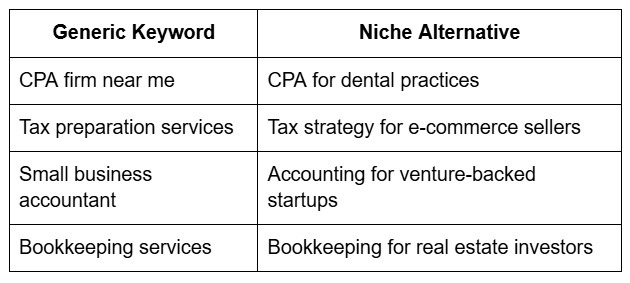
The niche searches have lower competition, higher conversion rates, and, more importantly, they attract clients who are already sold on specialization and willing to pay for it.
"The days of generic content ranking well are behind us," stated Rand Fishkin, the founder of SparkToro and Moz. Google wants to see depth, relevance, and demonstrated expertise on a specific topic for better positioning in search results.
How to Build Your Niche CPA SEO Industry Pages: A Step-by-Step System
Step 1: Pick Your Verticals Based on Real Data, Not Gut Feeling
Before beginning to write, please review your current client roster. What industries show up most? Which clients have the highest lifetime value? Which one refers to others most often?
From there, cross-reference with keyword research. Use a tool like Ahrefs, Semrush, or even free Google Search Console data to see if people are already searching for CPAs in those industries. If there are 200 to 2,000 monthly searches for "CPA for [your target industry]," that's a real market worth owning.
Quick framework for choosing your first three verticals:
- Pick one industry you already serve with three or more clients and understand well for effective lead generation.
- Pick one adjacent industry where your skills transfer and you have a clear pitch to attract your ideal client.
- Pick one "growth" vertical where demand is rising; SaaS, e-commerce, or short-term rentals are often strong bets.
Step 2: Structure Each Niche Page Like a Sales Page, Not a Blog Post
This is where most CPAs make mistakes. They create a niche page that reads like an about page. That won't convert anyone, and it won't rank either.
Each niche CPA SEO industry page needs the following sections:
A. A headline that names the specific audience
Not "Accounting Services." Instead: "Tax and CFO Advisory for SaaS Startups."
B. A pain paragraph that proves you understand their world
Write 2 to 3 sentences that describe the actual problems your target client faces. For SaaS: "Most founders don't know their burn rate until it's a crisis. Revenue recognition for subscription models is messy, and most general CPAs handle it wrong, which can create serious problems at due diligence."
C. Your specialized service list
What do you specifically do for this industry? Use terms that are specific to your field, such as "409A valuations," "R&D tax credits," or "Section 199A deductions for rental property owners." These are NLP and semantic keywords that signal expertise to both Google and the reader.
D. Social proof from that exact vertical
A client quote, a short case study, or even a specific outcome: "We helped a Series B SaaS company recover $85,000 in R&D tax credits they didn't know they qualified for."
E. An FAQ section
This is huge for both conversions and measurable SEO improvements. Answer 4 to 6 questions a prospective client in that industry would actually ask. This is where you capture featured snippet rankings and AI-generated answer visibility.
F. A clear CTA
Not "Contact Us." Instead: "Book a 30-minute call to see if we're the right fit for your [industry] business."
Step 3: Write Content That Reflects Real Industry Knowledge
You can't fake this part, and you shouldn't try to refine your approach. Google's Helpful Content system and E-E-A-T framework (Experience, Expertise, Authoritativeness, Trustworthiness) are specifically designed to filter out surface-level content.
What does real industry knowledge look like on a page?
For a dental practice CPA page, it means referencing DSO structures, the tax implications of owning vs. leasing equipment, and the difference in entity type for solo practitioners vs. group practices.
For a CPA page for real estate investors, it means talking about cost segregation studies, depreciation recapture, and 1031 exchange timelines.
You don't need to write a textbook. But you do need to demonstrate that you've sat across from 20 clients in this industry and understand what keeps them up at night. That's the content that ranks and converts.
Step 4: Build Internal Links Between Your Pages
Once you have three or more niche pages built, link between them. Your SaaS page can link to your "Accounting for Startups" blog post. Your healthcare CPA page can link to a post about "Medical Practice Tax Deductions You're Missing."
This internal link structure tells Google your site has topical depth on CPA services for specific industries, which is exactly what builds domain authority over time.
According to Semrush's 2024 State of Content Marketing Report, websites with strong internal linking structures see up to 40% more crawled and indexed pages than those without one. More indexed pages means more traffic opportunities and better positioning in search engine results.
The Real ROI of Niche CPA SEO Industry Pages
Let's put some numbers on this so it feels real and relevant to your ideal client.
Say you build five niche industry pages. Each one targets a keyword with 300 to 500 monthly searches. With decent on-page SEO and a few supporting blog posts, you might realistically expect each page to drive 30 to 80 qualified visitors per month within 6 to 12 months.
At a 5% conversion rate to a consultation, that's 1 to 4 new consultations per page, per month. If your average advisory engagement is worth $6,000 to $15,000 per year, you're talking about real, compounding revenue from content you built once, which is a powerful metric for success.
Compare that to paying $50 to $100 per click on Google Ads targeting generic CPA keywords. The economics aren't close.
And here's what makes this really compound: once you own a niche, referrals start happening within that industry. Dentists talk to other dentists. SaaS founders post in Slack groups. Your reputation in a vertical feeds itself.
What Makes This System Work on Webflow, Specifically
If your site runs on Webflow (and it should, if rankings and speed matter to you), you have a structural advantage here. Webflow lets you build clean, fast-loading niche pages without fighting plugins or dealing with template limitations.
More importantly, Webflow's CMS lets you create scalable page templates where you can build niche CPA SEO industry pages with consistent structure, proper heading hierarchies, schema markup-ready layouts, and clean URLs, all without touching code.
That matters because Google reads your page structure as a signal of organization and credibility, impacting your local SEO efforts. A page built in Webflow with the proper H1/H2/H3 structure, fast load times, and mobile responsiveness will outperform a bloated WordPress page targeting the same keyword, all else being equal.
A Common Mistake: Trying to Target Everyone at Once
When CPAs first hear about niche pages, the instinct is to build 10 of them immediately. That's the wrong move.
Start with two or three industries. Go deep. Write 800- to 1,200 word pages. Add a supporting blog post per niche to enhance your digital marketing strategy. Build the internal links. Then wait 90 days and see what Google does with it. Once you see traction, expand.
Trying to own every vertical before you've proven traction in one is how you end up with a dozen mediocre pages instead of three dominant ones.
Conclusion: Stop Competing with Every CPA in Your City. Start Owning Your Niche.
The accounting market is not short on CPAs, making it a competitive space for digital marketing optimization. It is short on CPAs who clearly specialize, speak the language of specific industries, and show up in Google when those exact clients are searching.
Building niche CPA SEO industry pages is not a gimmick. It's a structured system for becoming the obvious choice in the specific verticals you want to own. It takes a few months to gain traction, but once it does, it compounds in a way no ad budget can replicate.
If you're a CPA who's tired of competing on price with generalists, and you're ready to attract the kind of clients who see you as a strategic partner rather than just a tax preparer, this is the system that gets you there.
Ready to build a niche authority system for your CPA practice? Book a free strategy session with Progeektech, and we'll map out which industry pages make the most sense for your firm and what it would take to rank for them in the next 90 days.
Schedule your FREE discovery call right now → https://www.progeektech.com/1on1-strategy