


.jpeg)
You are a great dentist. Your patients really like you. But the sad truth is that none of this matters if people can't find you online.
Someone in your area is using their phone to look for a "dentist near me" right now. They have a sore tooth. They need help right away. They want to make an appointment today, not next week. But if your practice isn't in the top three Google Maps results, people won't know about it. Instead, they'll call your competitor.
Does this sound familiar? You're not the only one.
Recent studies show that the Google Map Pack gets almost half of all local search clicks, and the top three listings in Google Maps get more than 70% of all clicks. That's the difference between having a full appointment book and having empty chairs.
But most dentists don't know they don't need the most expensive website or spend thousands on ads to get to the top of Google Maps. You need to know how local SEO for dentists works and then follow a specific path to get there.
In 30 days, I'll show you exactly how to do it.
The Problem of The Invisible Practice
Let's talk about what really happens when people who need dental care look for it.
More than 70% of patients now use Google to look for doctors and other health care professionals. People aren't asking their friends for referrals as much as they used to. People are taking out their phones and typing "dentist near me," "emergency dental care," or "teeth whitening in [your city]."
Google shows them the Local 3-pack, a map of three businesses at the top of the page, when they click "search." Studies show that businesses in the local 3-pack get 93% more calls and 126% more visitors. You can't be seen if you're not there.
Consider how you act. When was the last time you looked past the first page of Google? Most likely never. Your possible patients act the same way. Google's local algorithm puts dentists who are close to the searcher at the top of the list. The top three Google Maps results get more than 70% of all clicks.
And it gets worse. Your competitors who know how to do local SEO for dentists are working to improve their Google Business Profiles, get more reviews, and make their online presence stronger. They're getting patients who could have been yours every day you wait.
The price of being invisible is real. In the last five years, searches for "dentist near me" have gone up by more than 200%. That's a huge chance, but only if people can find you.
Why Local SEO for Dentists Is Different
You might be wondering, "Isn't having a website enough?"
Not even close.
When it comes to dentists, local SEO is very different from general search engine optimization. Healthcare searches are different from other searches because they are YMYL (Your Money, Your Life) searches. Google needs more trust signals because the stakes are higher.
This is what it means for your practice:
Being close is important, but it's not the only thing that matters. You don't have to be the dentist closest to you to be number one. Relevance (categories, keywords, FAQs) makes you show up even when you're not the closest choice.
When it comes to being seen in your area, your Google Business Profile is more important than your website. People are 70% more likely to click on a full GBP. Even if you're right around the corner, an incomplete or out-of-date profile will hurt your rankings.
Reviews are more than just social proof; they also help with rankings. Clinics that get a lot of real, honest feedback tend to do better than those that have higher ratings but fewer reviews. Google wants to see recent reviews that show you're actively helping patients with their specific needs.
Your Google Business Profile and your website must be exactly the same. Google checks your website against your GBP to make sure your practice is real, active, and useful. If your name, address, phone number, or services don't match up, it makes people doubt you and lowers your rankings.
The good news? When you know how these parts fit together, the way forward is very clear.
Step 1: Take control of and improve your Google Business Profile (Week 1)
Your Google Business Profile is like your online store. It's what people see when they look for you, and it's the most important part of your local SEO strategy.
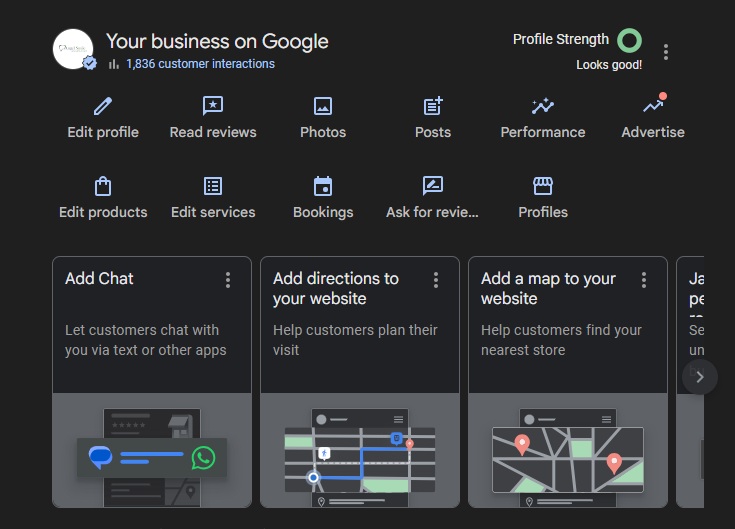
First, go to google.com/business and claim your profile. If someone else has already made one for your practice (which does happen), you'll need to claim it and prove that you own it. Google will send a postcard to your office with a code that you can use to prove your identity. Finish this step; profiles that aren't verified don't usually rank well.
Once you have confirmed your identity, fill out all of the fields:
Business name: Use the same name that is used everywhere else online. Don't put too many keywords in your business name, like "Best Family Dentist in LA." That could get you in trouble with Google.
These must match your website exactly: your address and phone number. The same format, punctuation, and everything else. Google gets confused by even small differences.
Business hours: Don't forget to list holiday hours. Change these whenever they do.
Select "Dentist" as your main category, and then add more specific categories like "Cosmetic dentist," "Pediatric dentist," or "Emergency dental service" based on what you offer.
Business description: Write a clear and natural description of your business that includes where you are and what you do. Tell us what sets you apart. Do not go over 750 characters. For instance, "We've been a family dentistry practice in [City] since 2010, and we offer general dentistry, cosmetic procedures, and emergency care on the same day. Our patients like how gentle we are and how late we are open."
Services: List all the services you offer and give a full description of each one. Use all of the characters. Use location keywords in a natural way, like "Our Invisalign services help people in [City] get straighter smiles without braces."
Upload at least 10 high-quality photos, such as the outside of your office, the waiting room, the treatment rooms, pictures of your staff, and a picture of your dentist. If you can, include a short video tour. Give your photos descriptive captions and names that are relevant to the picture (like "downtown-austin-dental-clinic-exterior.jpg").
Step 2: Make a system for collecting reviews (Week 2)
For dentists, reviews are the most important part of local SEO. 67% of clicks go to local map listings, and reviews directly affect who gets those clicks.
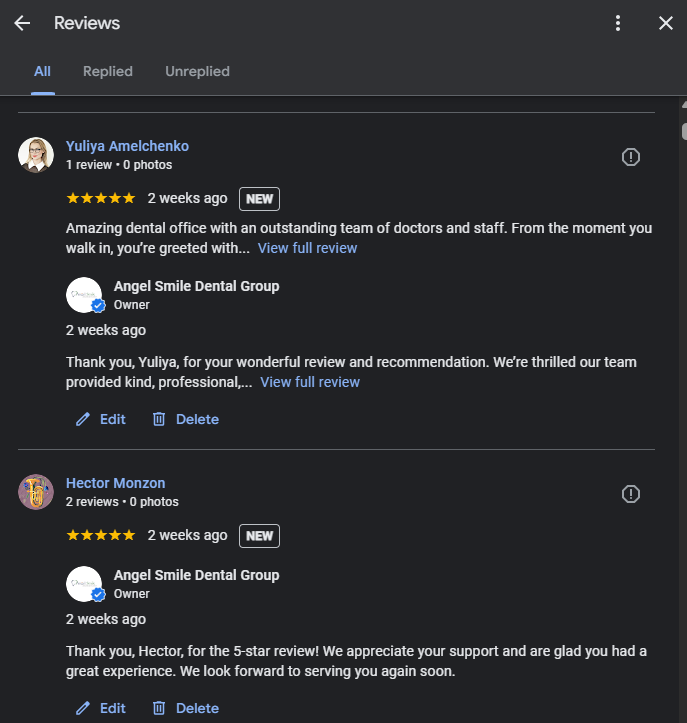
But here's the deal: most dentists don't ask for reviews. That's wrong. You need a plan.
This is what works:
At the right time, ask. The best time to ask for a review is right after a good experience, while the patient is still in your office. Teach your front desk staff to say something like, "We're so glad you had a great time today. Would you mind leaving us a quick review on Google? It really helps other people in [City] find us."
Keep it simple. Make a short link to your Google review page. You can find free tools to do this. Put it on your business cards, appointment reminder cards, and follow-up emails.
Be clear. Don't just ask for a review; ask them to talk about the service they got. "Please talk about how easy it is to make an appointment or how well we clean your teeth. That helps people understand what we do best."
Answer every review. Within 24 hours, thank people for good reviews. Be professional when responding to bad reviews and offer to fix problems in private. Patient reviews, especially those that are recent and specific to a service, help both rankings and trust.
Stay in line. Don't offer rewards for reviews (this is against Google's rules), and don't write fake reviews. Google is very good at finding patterns, and penalties can ruin your rankings.
Try to get 2 to 4 new reviews every month. Google thinks that steady, consistent growth is normal and will last.
Step 3: Make Service Pages for Each Location (Week 3)
Google needs to be able to easily see what services you offer and where you offer them on your website. This means making separate pages for each major service and, if necessary, for each location you serve.
This is how it should be set up:
Service pages: Make separate pages for each service, such as "Dental Implants," "Invisalign," "Emergency Dental Care," "Teeth Whitening," and "Family Dentistry." Each page should:
- Put the name of the service in the H1 heading.
- Use local keywords in a natural way, like "We provide dental implants to people in [City] who need them..."
- Use simple words instead of dental jargon to explain the service.
- Respond to frequently asked questions
- Include reviews from patients who have used that service
- Include clear calls to action, like "Book an appointment," "Call us," or "Get a free consultation."
Location pages: If you serve more than one area, you can make pages for neighborhoods near your office, even if you only have one office.
Technical parts are important:
- "Your Practice Name: Dental Implants in [City]" is the title tag.
- Meta descriptions should be less than 150 characters long and have a clear call to action.
- H1 and H2 tags: Use structured headers (one H1 and several H2s; don't use messy hierarchies)
- Internal linking: Link your service pages in a way that makes sense ("Our emergency dental services complement our general dentistry care...")
"Service + Location" pages help Google figure out how relevant you are in a certain area, even if your main office is in a different place.
Don't think too much about this. When you write, act like you're talking to a friend who needs help. Give them answers. Be clear about what you do and who you help.
Step 4: Make sure your citations are correct and consistent (Weeks 3–4)
Citations are when your practice name, address, and phone number (NAP) are mentioned on the web. Consistent citations across directories show that you are trustworthy and make your Map Pack more visible.
What is the problem? Most practices have information that isn't always correct on a lot of different websites. You might have used "St." instead of "Street" on one site but spelled it out on another. You could have put your office number on some sites and your cell phone number on others.
These mistakes make things hard for Google and hurt your rankings.
Here's how to clean up:
Check your current citations. Use Google to look up the name of your practice. Look at sites like Healthgrades, Zocdoc, Yelp, the American Dental Association, your local chamber of commerce, and dental directories.
Make a main document. Please write down the exact name, address, phone number, website URL, and hours of your business. Use this format everywhere.
Make sure things are consistent. Go to each site and make sure that the information there matches what is in your master document. Claim your profiles if you haven't already.
Focus on directories that are specific to dentistry, like ADA and local dental association listings (claim and fill these out). Dental practices care more about patient-facing directories like Healthgrades, Zocdoc, 1-800-Dentist, RateMDs, and others than they do about general business directories.
Put a reminder in. Every six months, look over your citations. The hours, phone numbers, and services all change. Make sure everything is up to date.
This work isn't glamorous, but it's important. Trust issues arise when there are small differences in how addresses or phone numbers are formatted.
Step 5: Keep an eye on your rankings and make changes as needed
You can't make things better if you don't keep track of them. The last step is to set up systems that will help you keep track of your progress and make changes based on the data.
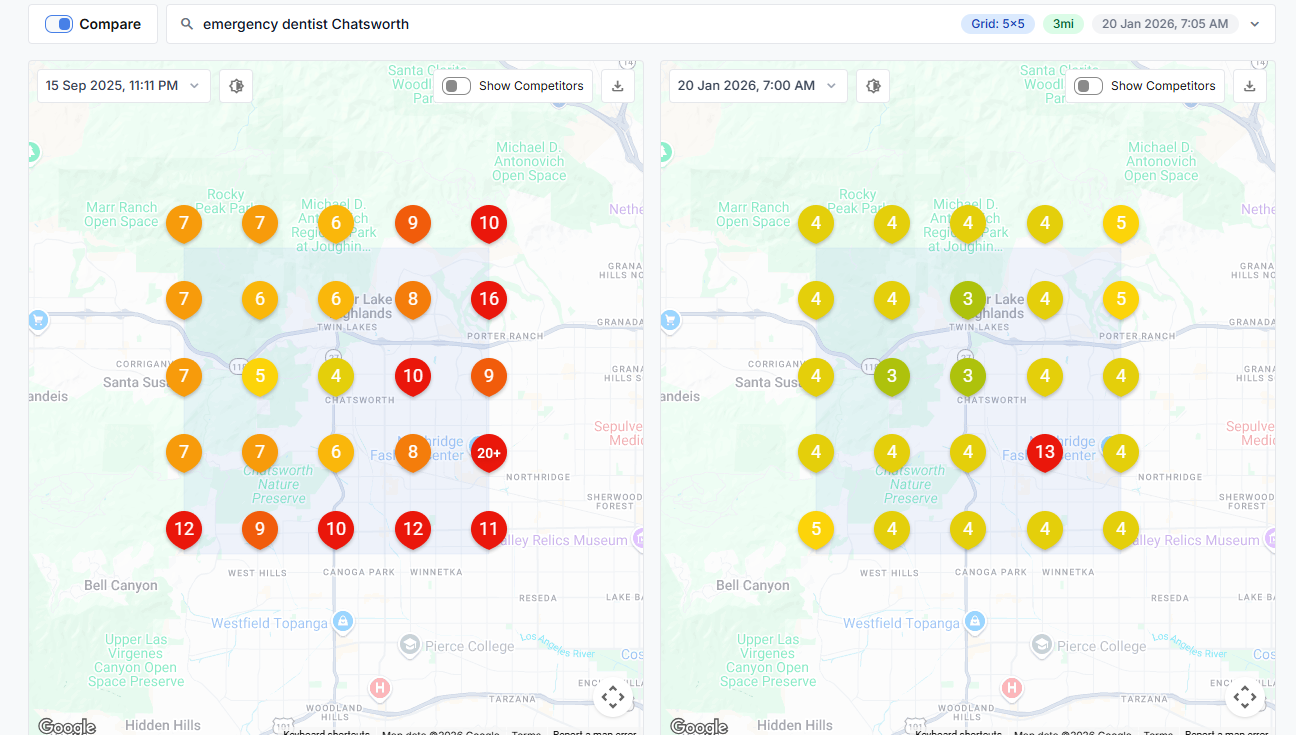
Keep an eye on where your keywords rank. Use tools to keep an eye on your rankings for important searches like "dentist near me," "emergency dentist [city]," "dental implants [city]," and other terms that are specific to your business.
Look at the heat maps. There will be a heat map for each keyword or service. A practice may do well for "dentist near me" but not for "Invisalign near me." Heat maps show you exactly where you are visible in your service area.
Keep an eye on the insights in your Google Business Profile. Google tells you how many people found you through search, how many clicked to get directions, how many called, and what search terms led to your listing. This information is very valuable.
Keep an eye on your competitors. Find out who always beats you. What are they doing that is different? How many reviews do they have? What services do they talk about?
Change things. If you're not getting many "pediatric dentist" searches, but that's a big part of your business, write more about pediatric care, add more pictures of your kid-friendly office, and ask parents to talk about pediatric services in their reviews.
The Roadmap for 30 Days
This is your full plan of action:
Week 1:
- Claim and check your Google Business Profile
- Fill out every field with correct information.
- Send in 10 or more good-quality photos and a video tour.
- Make sure the website is exactly like GBP
Week 2:
- Make a way to collect reviews
- Teach employees how to ask for reviews.
- Make links for reviews easy to find.
- Answer reviews that are already there
Week 3:
- Make or improve service pages for the five most important services.
- Add content that is specific to the area
- Make sure your title tags, meta descriptions, and headers are as good as they can be.
- Link pages to each other inside the site
Week 4:
- Check all the links on the web
- Make things consistent
- Claim profiles in the dental directory
- Make tools to track rankings
- Keep an eye on Google Business Profile insights
Why This Works (The Numbers Don't Lie)
Dentists' local SEO isn't just a theory. There is data to back up this system.
About 48% of all clicks go to a Map Pack listing. You get almost half of all local search traffic as soon as you get into that pack.
Most of the time, the phone calls and online bookings that dental clinics get come from Google searches in their area. The return on investment (ROI) is clear and easy to see.
High-intent traffic: This kind of traffic gets to people who are actively looking for care, like those who are looking for an emergency dentist nearby. These people aren't just looking around. They are people who need to see a dentist right away.
And local SEO keeps working even after you stop paying for ads. Long-term ROI: Unlike paid ads, this keeps bringing in new patients even after the first work is done. Your money grows over time.
What is really stopping you?
Let's be honest about how hard things are.
Takes time: It can take a few months to see big changes in your ranking. Ongoing effort needed: You need to review things regularly, add new content, and make technical updates.
This method isn't a magic switch. You won't be number one tomorrow. If you stick to these steps, though, you will see changes in 30 days.
The real question is not if local SEO for dentists works. The question is if you're willing to do what your competitors won't.
Most dentists set up their Google Business Profile and then forget about it. They don't pay attention to reviews. They write general content for websites. They don't keep track of their rankings.
That's your chance. If you follow these five steps in order, you will be able to take over local search in your area.
Your Next Move
You now have a clear plan for getting more patients through Google Maps in the next 30 days. The plans aren't hard; they just need to be carried out with focus.
Execution, on the other hand, takes time, knowledge, and constant work. If you run a busy dental office and have to take care of patients, manage staff, and deal with insurance companies, you might not have 10 to 15 hours a week to work on local SEO.
That's why Progeektech is an expert in local SEO for dentists. We've helped dental offices all over the country get to the top of Google Maps rankings, and we've seen big changes in the first 60 days.
Our unique marketing system takes care of everything, from optimizing your Google Business Profile to generating reviews, managing citations, optimizing your website, keeping track of everything, and making changes as needed. We become your local SEO team so you can focus on what you do best: taking care of patients.
Are you ready to get patients who are looking for dental services in your area?
Schedule your FREE discovery call right now → https://www.progeektech.com/services/webflow-seo. We'll look at how visible you are on Google Maps right now, show you how you compare to your competitors, and make a personalized 30-day action plan just for your practice.
No one-size-fits-all advice. No one-size-fits-all answers. We give you a clear plan to help you get more patients through local search strategies.
Every day you wait is another day that your competitors are getting patients who should have been yours.