


.png)
Here is a scenario that might sound familiar.
A potential client asks ChatGPT, "Who are the best accounting firms near me?" Your firm has been serving that neighborhood for 11 years. You have great reviews, a solid website, and a busy tax season every year.
But your firm does not show up.
Not in the AI response. Not in the top map results. Not anywhere a person who is actively looking for your services would actually see you.
And the reason is probably not your reviews. It is not your website either. It is something much less obvious, something most accountants never think about until a competitor starts eating their lunch: your local citation data is a mess.
What Is a Local Citation, and Why Should You Care Right Now
A local citation is any mention of your firm's name, address, and phone number online. That combination is usually called NAP data. It shows up on directories like Yelp, Yellow Pages, Clutch, Expertise.com, Manta, Apple Maps, Bing Places, and dozens of others.
Google uses citation consistency as a trust signal. If your firm's name appears as "Smith & Associates CPA" on your website, "Smith and Associates" on Yelp, and "Smith Associates Accounting" on Yellow Pages, Google sees three different entities and gets confused about which one is real.
And AI tools, especially large language models like ChatGPT and Perplexity, pull from many of those same directories and data aggregators when they are building their responses. A 2023 study by BrightLocal found that 80% of consumers lose trust in local businesses when they find incorrect information online. That was before AI search exploded. The stakes are significantly higher now.
This asymmetry is not a theory. It is a real gap that will cost accounting firms and real clients in 2026.
The Problem Is Worse Than You Think
For years, most accounting firms have maintained their listings in directories without any active management. You signed up a few years back, someone changed your office address, and nobody updated the Yelp page. Then, a data aggregator like Acxiom or Localeze scraped the old address and pushed it out to 40 other directories automatically.
Now you have:
- Three different phone numbers are floating around the internet
- Two different suite numbers for your office address
- Five different variations of your business name
- An old website URL pointing to a domain that no longer exists
Every one of those discrepancies tells Google and AI tools, "I am not sure if this business is real, active, or trustworthy."
According to Moz's Local Search Ranking Factors report, citation signals consistently rank among the top local pack ranking factors. And yet most accounting firms have never done a formal citation audit, not even once.
Why AI Tools Specifically Depend on Clean Citation Data
This is the part that most SEO guides miss, and it is the real reason doing a local citation audit for accounting firms in 2026 matters more than it did even two years ago.
When someone asks ChatGPT, Gemini, or Perplexity to recommend a local accounting firm, those AI tools do not crawl your website in real time. They reference:
- Bing's local index (which powers Bing Places and also feeds several AI products)
- Data from Yelp, with which ChatGPT has a formal partnership as of early 2023
- Apple Maps data (which pulls from TomTom and Yelp)
- Structured data from Google's Knowledge Graph
- Third-party aggregators like Data Axle, Neustar Localeze, and Foursquare
If your data is wrong or missing in these specific places, an AI tool simply will not mention you. It is not making a judgment about your firm. It literally does not have clean data to work with.
This procedure is different from how a human might search. A person might click through several results and figure out your real address. An AI model picks the data it finds and moves on.
How to Run a Local Citation Audit for Accounting Firms in 2026
Here is the actual system, broken into four steps. You can do this yourself or hand it to someone on your team.
Step 1: Nail Down Your Master NAP Record
Before you can rectify anything, you need to decide what the correct information is. Write it down exactly as it should appear everywhere:
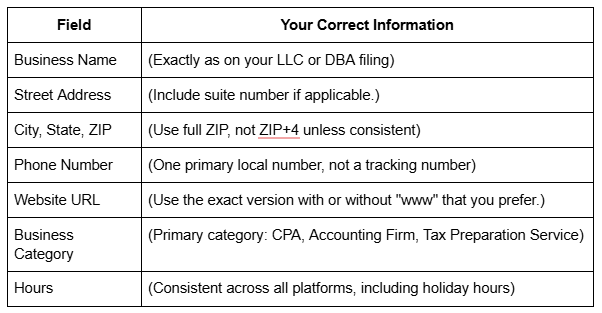
This is your master record. Every listing needs to match it exactly, including punctuation and capitalization.
Step 2: Audit the Directories That Actually Matter in 2026
Not every directory carries equal weight. Focus your audit on the ones that feed AI tools and Google directly:
Tier 1: Correct these first:
- Google Business Profile (the most important one by far)
- Bing Places for Business
- Apple Maps (claim it via Apple Business Connect)
- Yelp
- Facebook Business Page
Tier 2: These feed the AI ecosystem:
- Data Axle (formerly Infogroup)
- Neustar Localeze
- Foursquare
- Acxiom
Tier 3: Industry-specific directories for accounting:
- CPAdirectory.com
- Expertise.com
- Clutch.co
- FindAccountants.com
- AICPA member directory (if applicable)
You can use tools like BrightLocal, Whitespark, or Semrush's Listing Management tool to pull a snapshot of your current citation status across all of these. A basic BrightLocal audit costs around $2 to $3 per location and gives you a clear picture of where you stand.
Step 3: Document Every Discrepancy
Build a simple spreadsheet. Here is the template:
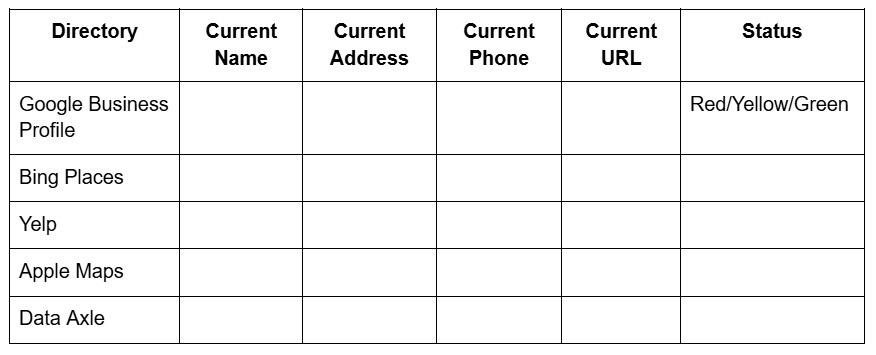
Use Red for wrong information, Yellow for missing information, and Green for correct. This spreadsheet becomes your cleanup roadmap.
Step 4: Fix, Claim, and Suppress
Fixing: For directories where you already have a claimed listing, log in and update the information manually to match your master NAP record.
Claiming: For directories where your listing exists but is unclaimed (common with Foursquare and some data aggregators), go through their verification process. This usually takes 1–7 business days.
Suppressing: If you find duplicate listings for your firm on the same platform, flag them for removal. Google has a process for this inside your Google Business Profile dashboard. For third-party directories, you usually need to contact support directly.
One thing to flag here: fixing the Tier 2 data aggregators is critical because they push data outward to many other directories automatically. If you repair a Data Axle and Localeze, many of those downstream directories will correct themselves within 60 to 90 days without you having to log into each one.
The AI Visibility Gap Most Accounting Firms Miss
Here is a specific item that a local citation audit for accounting firms in 2026 should include, which older guides do not mention.
Yelp's data partnership with ChatGPT means that if someone asks ChatGPT for accounting firms in your city and your Yelp listing has the wrong phone number or a low review count, you will either appear incorrectly or not at all. According to OpenAI's documentation and various SEO researcher reports from 2023 and 2024, ChatGPT uses Yelp as a primary local data source for real-time recommendations.
Perplexity AI relies heavily on Bing's index. Google's AI Overviews utilize Google's Knowledge Graph, partly derived from your Google Business Profile and verified citation signals.
So the old advice of "just make sure Google is correct" is no longer enough. You need clean data across the full ecosystem.
Here is a quick checklist for AI-specific visibility:
- Yelp listing claimed the correct NAP, at least 10 reviews with responses
- Bing Places verified and matching the Google Business Profile exactly
- Apple Business Connect claimed and updated
- Foursquare listing claimed (Foursquare feeds many apps and AI products)
- Schema markup on your website using LocalBusiness structured data
That last one, schema markup, is something your web developer or Webflow agency can implement in a few hours. It tells Google and other crawlers the exact structured data about your firm, acting as a direct signal rather than making them guess from your content.
How Long Does This Take, and Can You Do It Yourself
Honest answer: a thorough citation audit and cleanup for a single-location accounting firm takes about 6 to 12 hours of total work spread over a few weeks, since some verifications require waiting for postcards or emails.
If you want to do it yourself, the process above gives you everything you need. Set aside one Saturday morning to complete the audit and documentation, and then work on the fixes over the next two to three weeks.
If you would rather hand it off, a local SEO agency typically charges $300 to $800 for a full citation audit and cleanup for a single-location firm. The ongoing citation management, keeping things clean as you move offices or change your hours, runs around $50 to $150 per month, depending on the provider.
The ROI math is simple. If one new client from an AI-driven search finds you because your Yelp listing is correct, and that customer brings in even a $2,000 annual tax prep engagement, you have covered the cost of professional citation management for years.
What Happens After You Clean Things Up
Once you maintain consistency in your citations and accurately claim your AI-visible directories, you can reasonably anticipate the following benefits:
- Improved local pack rankings over the next 60 to 90 days as Google recalibrates trust signals
- Better performance in AI-generated local recommendations, especially for voice search and mobile queries
- Fewer "wrong address" calls from confused prospects
- A stronger foundation for any additional local SEO work, because everything else (reviews, backlinks, content) builds on top of citation trust
One thing worth noting: citation cleanup is not a one-time project. Businesses move. Phone numbers change. Data aggregators sometimes overwrite your corrections with old data. Checking your core listings every quarter takes about 30 minutes and keeps things from drifting.
A Note on What AI Tools Still Cannot Do
AI tools are getting better at local recommendations, but they still have real blind spots. They cannot always distinguish between a firm that is actively practicing and one that closed two years ago if the directory data has not been updated. They sometimes pull from outdated aggregator records. And they do not always prioritize review quality over review quantity.
This finding is actually good news for you. It means that a smaller accounting firm that does a thorough local citation audit for accounting firms in 2026 can genuinely outperform a larger competitor that has ignored its citation health. Clean data is an underrated competitive advantage right now.
Conclusion: Your Visibility in 2026 Starts With the Basics
The accounting firms that will win local search over the next few years are not necessarily those with the biggest ad budgets. They are the ones who understand how Google and AI tools actually work and make sure their data is clean at every point in the ecosystem.
A citation audit is not glamorous work. But it is one of the highest-leverage things you can do for your firm's local visibility right now, especially as more potential clients start asking AI tools for recommendations instead of typing into a search bar.
You have built a firm worth recommending. Make sure the data is there so AI tools and Google can actually recommend you.
Ready to find out exactly where your firm stands? At Progeektech, we run full local citation audits for accounting firms and fix what is broken, including your AI-era directory presence. Book a free strategy session, and we will show you your current citation health score and what it is costing you in missed leads.
Schedule your FREE discovery call right now → https://www.progeektech.com/1on1-strategy