

You did everything the SEO checklists told you to do. Keywords in your headers, meta descriptions written, a blog you update most months, and maybe even a few backlinks you paid too much for. And your traffic still isn't turning into calls, demos, or sales.
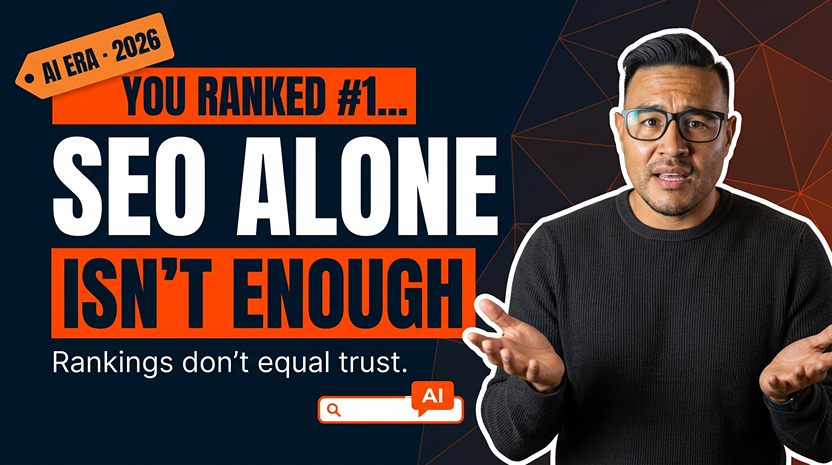
You're not doing SEO wrong. SEO just isn't the whole job anymore, and pretending it is will keep you stuck.
This one matters for SaaS founders watching signups plateau, accountants who built a nice-looking site that nobody calls, and local business owners who rank on page one for a keyword that barely gets searched. So let's get into why "rank higher" stopped being a strategy on its own and what actually replaces it.
The Problem: Search Doesn't Work the Way It Did Two Years Ago
Google used to hand you a click when you ranked well. That deal is falling apart.
Google's AI Overviews now show up on roughly a quarter of all searches, and that share keeps climbing. When one appeared, a 2026 field study using a randomized, pre-registered design found outbound organic clicks dropped by 38% on the queries where the AI overview showed up, with zero-click searches rising from 54% to 72% of all searches in that group. Seer Interactive's year-long analysis of over 5 million tracked queries and 2.4 billion impressions found something similar: organic click-through rate on AI Overview pages fell from 1.76% to 0.61%, a 61% drop, and Pew Research found users click an organic result only 8% of the time once an AI Overview appears, compared to 15% when it doesn't.
Here's the part that should worry you if your whole plan is "rank #1 and wait": comparison searches, the "X vs Y" and "best [thing] for [industry]" queries that service businesses live on, trigger an AI overview over 95% of the time. Question-based searches aren't far behind. If your content strategy leans on comparison pages and how-to guides, a good chunk of that traffic is already gone or going.
Ranking is still worth chasing. It's just no longer the finish line.
Agitate: What Happens When SEO Is Your Only Plan
Picture the accountant who ranks second for "tax firm near me" but has a homepage built for 2019, no clear next step, and a contact form that emails a mailbox nobody checks. Or the SaaS founder whose blog brings in visitors who read the article, get their answer straight from the AI summary above it, and never click through at all.
Both of them did the SEO work. Neither built the system around it that turns a visit into a client.
That's the real risk of treating SEO as a standalone service instead of one piece of a bigger machine. You can win the ranking and still lose the business because:
- Page speed and Core Web Vitals now decide both your rank and your conversion rate. Sites that load in under two seconds convert at roughly 2.9%, while sites over five seconds convert at 0.6%, based on Portent's conversion-rate research. That's not a small gap. That's most of your leads.
- A slow, cluttered, or confusing site still loses the visitors who do click through, no matter how well the page ranks.
- Rankings without a follow-up system (email, retargeting, a CRM that actually gets used) waste every dollar you spent getting the click in the first place.
If you've been searching for the best Webflow SEO expert because you assumed better keyword targeting would fix your lead flow, this is worth sitting with for a second: keyword targeting was never the bottleneck for most of the businesses we work with. The system around it was.
The Solution: What a Best Webflow SEO Expert Actually Builds
A good Webflow SEO expert doesn't hand you a keyword list and call it a strategy. The job is bigger than that, and it has to be, given everything above.
1. Speed and structure that Google and AI systems can both read
Webflow's clean code output and built-in performance tools give you a real head start on Core Web Vitals, but only if someone sets it up right. Fast, well-structured pages do two jobs at once: they rank better, and they give AI overviews and tools like ChatGPT clean, well-organized content to pull from and cite. Getting cited inside an AI overview isn't a consolation prize either. Brands cited in AI Overviews earn roughly 35% more organic clicks than brands that show up but aren't cited, according to Seer Interactive's research.
2. Content built to answer, not just to rank
Short, direct answers near the top of the page, clear headings, and real data give both search engines and AI tools something worth quoting. Generic, fluffy content doesn't get cited by anything or anyone.
3. Conversion design, not just landing pages
A page that ranks but doesn't convert is a page that costs you money for nothing. This is where a Webflow SEO expert and a conversion designer really need to be the same person, or at least working off the same plan: clear calls to action, forms that don't scare people off, and a path from "found you on Google" to "booked a call" that doesn't have five unnecessary steps in it.
4. Automation that catches the lead you already earned
Ranking gets someone to your site. Automation is what makes sure that the person doesn't fall through the cracks. Instant follow-up emails, lead scoring, and a CRM that's actually connected to your marketing (not a separate spreadsheet nobody updates) turn a visit into a booked call instead of a bounce.
Why This Matters More for Some Businesses Than Others
If you run a SaaS company or startup, your buyers are researching fast and comparing options faster, often inside AI tools, before they ever land on your site. You need to show up in that research phase, not just the click.
If you're an accountant or an accounting firm, trust and local relevance decide whether someone calls you or the firm three listings down. Speed, clear pricing pages, and easy scheduling matter as much as your rank does.
If you're a local small business, "near me" searches now show an AI overview about 77% of the time, layered right on top of the local map pack you're used to competing for. Showing up once isn't enough. You need to show up in both places and give people a reason to click through instead of stopping at the summary.
What This Looks Like in Practice
A client we worked with had solid rankings and a Webflow site that looked professional, but their contact form conversion rate sat under 1%, and their average page load time was pushing four seconds on mobile. We rebuilt the page structure for speed, tightened the content so it answered the visitor's actual question in the first two sentences, and connected their form to an automated follow-up sequence instead of a static "thanks, we'll be in touch" message. None of that touched their keyword rankings directly. All of it touched their revenue.
That's the difference between hiring someone to chase rankings and working with a best Webflow SEO expert who treats SEO as one input into a bigger growth system, not the whole system.
Frequently Asked Questions
Is SEO still worth doing in 2026, given how much AI overviews have changed search?
Yes, but the goal has shifted. Ranking still matters, and it's still often how you get found and get cited inside an AI overview in the first place. It's just not enough on its own anymore. Pair it with a fast, well-built site and a follow-up system, or you're leaving most of the value on the table.
What's the real difference between "SEO" and a full marketing system?
SEO gets you found. A full system (speed, conversion design, automation, and follow-up) is what turns being found into a booked call or a sale. One without the other usually means you're paying for traffic that doesn't convert.
Why does Webflow matter for SEO specifically, compared to something like WordPress?
Webflow's clean code and built-in performance controls make it easier to hit strong Core Web Vitals scores without a pile of plugins slowing things down. That speed advantage helps both traditional rankings and how well AI tools can read and cite your content.
How long does it take to see results from a Webflow SEO and conversion strategy?
Site speed and conversion fixes can move the needle within weeks. Ranking improvements from content and technical SEO usually take a few months to show up clearly, since Google needs time to recrawl and re-evaluate your pages. A realistic timeline is 60 to 90 days for early movement and 6 months for compounding results.
Ready to Stop Losing Leads to a Site That Ranks but Doesn't Convert?
If your rankings look fine but your calendar doesn't, the gap probably isn't your keywords. Get a free 30-minute growth audit and find out exactly where visitors are dropping off and what to fix first. Book your free growth audit here.