


The Short Answer
Most US bookkeepers should charge between $300 and $1,500 per month for a standard retainer in 2026, with a typical mid-market engagement landing around $500 to $750 per month. Basic bookkeeping for a business under $250,000 in revenue sits near $300 to $450. Full-cycle monthly bookkeeping with payroll, AR/AP, and multi-account reconciliation runs $800 to $1,500 and up. Monthly transactions, not hours, is the number that should set your price.
That range is the market. It is not your number. Your monthly retainer needs to cover your overhead, your target salary, and a real profit margin, and it needs to be packaged in a way a small business owner can say yes to in one conversation. That second part is where most accounting and bookkeeping firms lose money, and it is the part nobody teaches.
I have watched dozens of firms price their bookkeeping service into a corner. The books are clean, the client is happy, and the owner is exhausted and underpaid. Almost every time, the problem traces back to three things: hourly pricing, saying yes to work that was never in the engagement, and a website that never sets the price expectation before the discovery call.
How Much Does a Bookkeeper Cost in 2026? (Real Numbers)
Here is the current picture of bookkeeping rates across the US market. The average hourly rate for bookkeepers runs $30 to $90 per hour. Monthly bookkeeping cost spans roughly $300 to $2,500, with most standard engagements clustering between $300 and $1,500 per month.
Break the cost of bookkeeping down by client size and it gets more useful:
- Under $250,000 in annual revenue. Expect $200 to $500 per month. Low transaction volume, one or two bank accounts, cash basis, a simple monthly close.
- $250,000 to $1 million in revenue. Expect $500 to $1,500 per month. More monthly transactions, credit card feeds, sales tax, maybe light payroll support.
- $1 million to $3 million in revenue. Expect $1,500 to $3,000 or more. Payroll, multiple accounts, accrual basis, a real close calendar, and often a monthly review call.
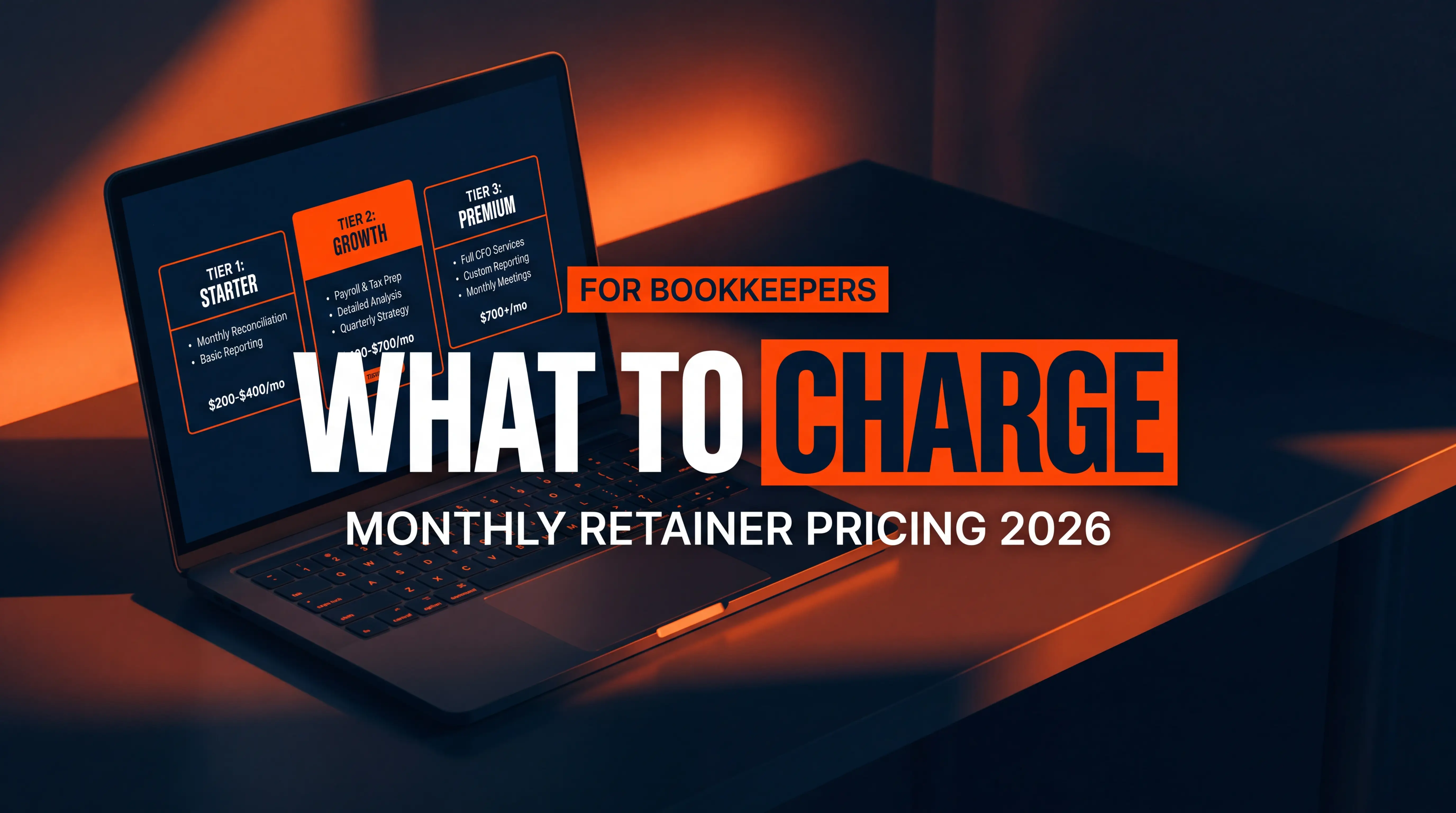
A widely used three-tier package model in 2026 looks like this: Basic at $300 to $450 for up to 50 transactions, Standard at $500 to $750 for 50 to 200 transactions with weekly categorization and payroll integration, and Advanced at $800 to $1,500 for 200-plus transactions, multi-state work, inventory, and an advisory layer. Those are the bookkeeping prices a prospect will see quoted almost everywhere they look, so your own package needs to be legible next to them.
Pro tip: anchor each tier to a time budget before you publish it. Three to five hours for Basic, six to ten for Standard, twelve to twenty for Advanced. If your effective hourly rate on any tier drops below $75 per hour, the tier is mispriced, not the client.
What Does an In-House Bookkeeper Cost by Comparison?
Every prospect who asks "how much does a bookkeeper cost?" is silently running a second calculation, so it helps to answer it for them. Hiring an in-house bookkeeper in 2026 means a bookkeeper salary in the $48,000 to $65,000 range, plus payroll taxes, benefits, software seats, and management time. All in, in-house bookkeeping realistically costs a small business $60,000 to $85,000 a year before anyone has closed a single month.
Set against that, a $750 per month retainer is $9,000 a year. Outsourcing bookkeeping is not the cheap option in some abstract sense, it is the option that matches the work to the actual business needs of a company that does not have forty hours a month of business bookkeeping to hand out. That framing is the cost savings argument, and it belongs on your pricing page, not just in your head.
It also reframes the conversation for the small business owner who is comparing you to an online bookkeeping service with a $199 sticker. You are not competing on the lowest total cost. You are competing on whether their bookkeeping needs are actually met by a platform that never picks up the phone.
How Do You Set Your Own Monthly Retainer Price?
Copying a competitor's price list is the fastest way to inherit their margin problems. Build your number from the inside out instead. It takes about twenty minutes with a spreadsheet.
- Find your true cost per hour. Add your target annual salary, your software stack, your subcontractor costs, insurance, and taxes. Divide by your realistic billable hours for the year. Most solo bookkeepers bill 1,000 to 1,200 hours, not 2,000. Be honest here or every number after this one is fiction.
- Add your profit margin. Cost recovery is not a business. Add 25 to 40 percent on top of your cost per hour. That is your floor rate.
- Scope the engagement in writing. Count the transactions, the bank and credit card accounts, the payroll runs, the sales tax filings, and the reporting deadlines. Estimate the hours honestly, then add 20 percent for the reality of client responsiveness.
- Multiply and round up. Floor rate times estimated hours equals your monthly retainer. Round up to a clean number. $687 becomes $750.
- Sanity-check against the market. If your number lands far below the ranges above, you have underestimated your hours. If it lands far above, you may be scoping work the client did not ask for.
This is the same math discipline behind pricing advisory services as an accountant, just applied to recurring compliance work.
Should Bookkeepers Charge Hourly or a Fixed Monthly Fee?
A flat monthly fee, in almost every case. Here is the honest reason: hourly pricing punishes you for getting better.
If automation and AI let you close a set of books in four hours instead of eight, an hourly rate hands the client a 50 percent discount for your efficiency. Fixed-fee and value-based pricing let you keep the gain. Firms that present value-based pricing with confidence report meaningfully higher close rates than firms quoting an hourly cost, because the buyer is comparing an outcome, not a timesheet.
Fixed pricing also changes the conversation. An hourly quote makes the prospect ask "how many hours will this take?" A packaged retainer makes them ask "which tier fits me?" The second question is a much easier sale, and it moves the discovery call from negotiation to selection.
Hourly still has two legitimate uses: catch-up and cleanup projects where the mess is genuinely unknown, and one-off consulting outside the retainer. Price those separately, quote them as a project fee once you have seen the file, and never let them quietly bleed into the monthly engagement.
How Do I Stop Scope Creep From Eating My Margin?
Scope creep is the silent killer of fixed-fee bookkeeping. A client adds a second entity. Payroll goes from four employees to eleven. Receipts start arriving by text message. The fee never moves.
The fix is not confrontation. It is definition, written down before the work starts.
Your engagement letter should name the exact boundaries: "monthly reconciliation of three bank accounts and two credit cards, up to 250 transactions per month, accrual basis, monthly P&L and balance sheet delivered by the 15th." Anything outside that line has a named price attached to it in the same document, so the upsell conversation is already pre-agreed.
Three habits protect the margin:
- Track transaction counts monthly. When a client crosses their tier ceiling twice in a row, that is your trigger for a tier conversation, not a feeling.
- Schedule a pricing review at month twelve. Put it in the engagement letter so the annual adjustment is expected, not a surprise.
- Have a change-order price ready. "That is outside the current scope. I can add it for $175 a month starting next cycle." One sentence, no apology, no free work.
Where Does Pricing Fit in the Convert Smart Growth System?
At Progeektech we run every small business client through the same three-stage framework: Get Found, Land Client, Retain and Grow. Your retainer price touches all three, and treating it as a purely internal accounting decision is why so many firms stay stuck.
Get Found. Buyer-intent searches like "average cost of bookkeeping services," "bookkeeping services for small business," and "how much does a bookkeeper cost" are some of the highest-value queries in your market. If your site does not answer them, you are handing that traffic to directories and calculator pages. A pricing page and an honest pricing article are lead-generation assets, not just information. The same logic drives SEO for bookkeepers and shows up in how bookkeepers get clients on LinkedIn.
Land Client. Price transparency filters your pipeline before it wastes your calendar. When the tiers are visible, the prospects who book are already comfortable with the range, and your close rate climbs without a single new lead. That is exactly what a strong bookkeeper pricing page is built to do, and it is also why so many firms watch prospects ghost after the discovery call: the number was a surprise.
Retain and Grow. A well-priced retainer with clear deliverables gives you room to actually serve the client, which is what makes the annual increase easy and the referral natural. Underpriced clients get rushed work, and rushed work churns. Your client onboarding sequence is where you set that expectation on day one.
How Do You Present the Price Without Losing the Deal?
The number matters less than the frame around it. A few things move the needle consistently.
- Lead with the outcome, not the task list. "Books closed and reviewed by the 15th, so you always know your cash position before you make a decision" sells better than "monthly reconciliation and categorization."
- Show three tiers, always. A single price is a yes-or-no question. Three tiers is a which-one question, and most buyers pick the middle. Make the middle the one you want to sell.
- Put a starting price in public. "Plans start at $450 per month" does more qualification work than any contact form field. It also builds trust, which matters because the trust signals on your site, real testimonials, credentials, and named results, do half the selling before you speak.
- Add a risk reversal. A 30-day out or a first-month satisfaction guarantee removes the stall that kills most service deals.
- Never discount to close. Reduce the scope instead. Dropping the price teaches the client that your number was never real. Moving them down a tier keeps your effective hourly rate intact and leaves an upgrade path open.
If your site is converting below the realistic conversion rate for an accounting firm, the pricing presentation is usually one of the first three things to fix.
Frequently Asked Questions
How much should a new bookkeeper charge per month?
Start at $300 per month for small, low-volume clients rather than competing on the bottom of the market. Charging $150 to "get experience" sets an anchor you will spend two years undoing, and those clients are usually the most demanding. An experienced bookkeeper with a clear niche can open above that range on day one. If you need volume fast, cap the discount at a defined introductory period with a written step-up date.
Is outsourced bookkeeping cheaper than hiring in-house?
For most small businesses, yes. Hiring an in-house bookkeeper costs $60,000 to $85,000 a year once salary, taxes, benefits, and software are included, while a full-service outsourced retainer runs $6,000 to $18,000 a year. In-house bookkeeping only wins when transaction volume and complex bookkeeping needs genuinely justify a full-time seat.
Should I charge a setup or cleanup fee?
Yes. Cleanup is a separate project with its own scope and its own price, usually $500 to $3,000 depending on how many months are behind and how bad the file is. Quote it only after you have reviewed the actual books. Bundling cleanup into the first monthly retainer is the single most common way new bookkeepers lose money on a good client.
How often should I raise my bookkeeping rates?
Annually, on a fixed date written into the engagement letter, typically 3 to 8 percent for existing clients in good standing. Re-price immediately if a client's transaction volume or entity count changes materially. Silent absorption of extra work for years, then a 40 percent jump, is what actually causes clients to leave.
Do I have to publish my prices on my website?
You do not have to publish exact figures, but publishing a starting price or a tier range is almost always net positive for a small firm. It filters out the wrong-fit buyers, shortens the sales cycle, and answers the question searchers are actually typing. Firms that hide pricing entirely tend to book more calls and close fewer of them.
Getting the Price Right Is a Growth Decision
Your monthly retainer is not an accounting entry. It is the number that decides how many clients you need, how much time you can give each one, and whether the firm you are building is one you will still want in three years. Get your bookkeeping prices right and everything downstream gets easier: fewer clients, better clients, more margin, and more room to grow your business with advisory and accounting services that people actually pay well for.
If you are guessing at your pricing, or your website is sending buyers to a contact form with no price context at all, that is a fixable problem and usually a fast one.
Book a Free Growth Call and we will look at your pricing page, your positioning, and where your leads are dropping off, then map it to the Convert Smart Growth System so you stop trading margin for volume.