


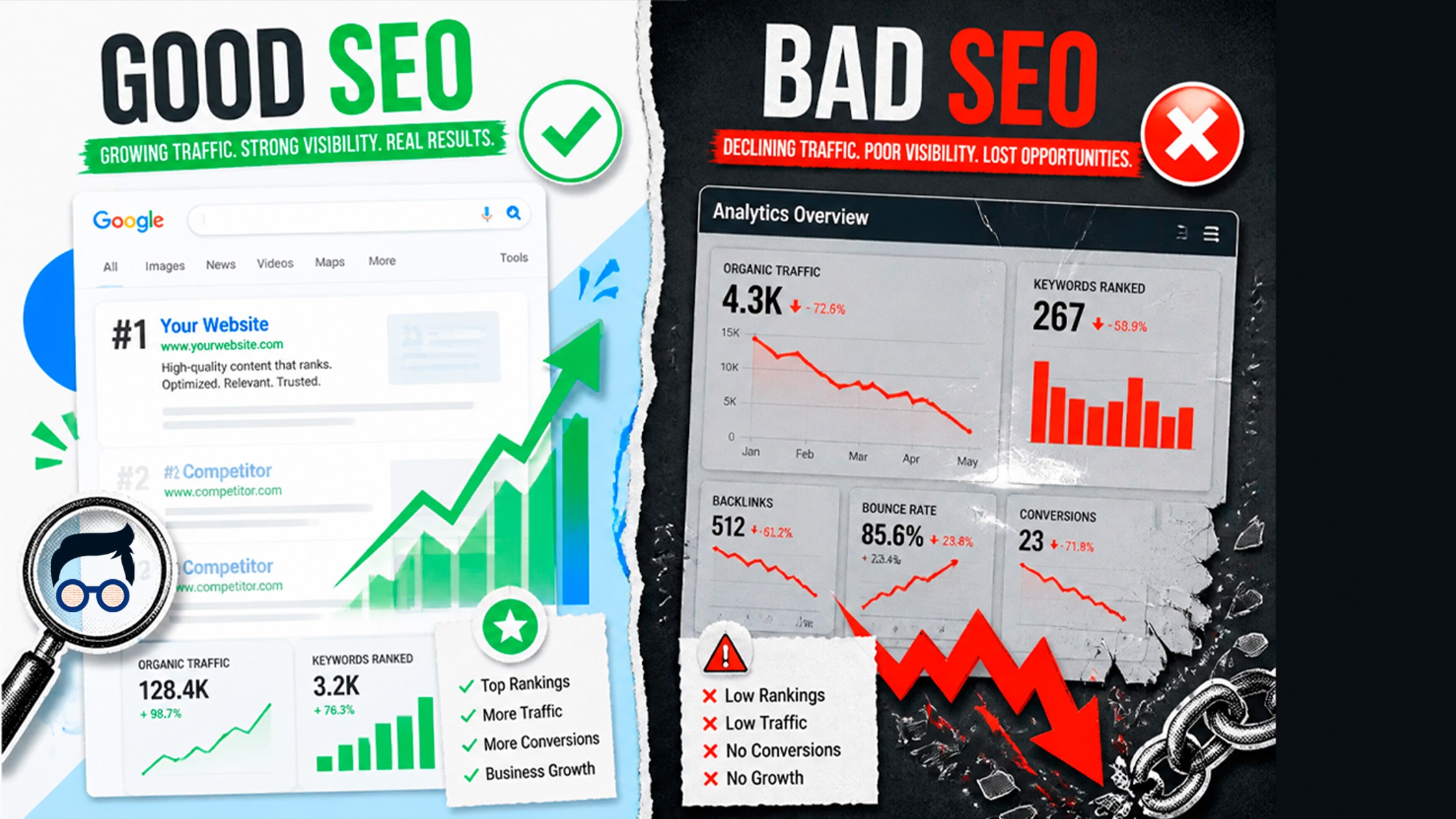
You've probably been there, trying to maintain your credibility as the SEO world changes. Someone sells you SEO, guarantees you page one rankings in 30 days, and maybe even throws in a "money-back guarantee." You sign up, pay the retainer, and a few months later, you are wondering why nothing has changed. Or worse, your rankings dropped.
That’s not an SEO problem. That’s a bad SEO vendor problem.
The reality is that the difference between good and bad SEO is not just about strategy. It’s the difference between growing your business and quietly wasting your marketing budget. And for small businesses, SaaS companies, accounting firms, and local service providers, getting this wrong is costly. Getting it right? That can change all that.
Let’s dive into what exactly sets the two apart and how to ensure you’re working with the right team.
Why SEO Is More Important Than You Realize
One thing we should clear up before we get into good SEO vs. bad SEO: SEO isn’t dead. Not even close.
Google still receives around 90% of all clicks from natural results, and paid ads only account for 10%. That 90/10 split held, even as Google announced AI Overviews and other big interface changes that impacted search rankings. And just 0.63% of users ever click on page two results, i.e., more than 99% of organic traffic goes to page one listings.
So if you’re not on page one, you’re pretty much invisible.
On average, a successful SEO campaign can return an ROI of around 748% or $7.48 for every $1 invested. Specifically, B2B SaaS companies reported an average 702% ROI on SEO. This same math is equally compelling for accounting firms and local businesses contemplating effective SEO practices.
But there’s one problem. Those numbers only come when you're working with people who know what they're doing.
The Problem: Most Companies Don’t Know The Difference
This is where it gets uncomfortable. Whether you run a small accounting firm or a growing SaaS startup, most business owners don’t have the time to become SEO experts. So you buy the pitch. You trust the agency. And sometimes that trust is misplaced.
Clients who spend less than $500/month on SEO are 75% more likely to be unhappy than those who spend more. But it’s not always a matter of price. That's what you are really getting for that spend.
Bad SEO companies are often guilty of using tactics that look good in a report but do very little for your actual business. You will get a monthly PDF report with “keywords tracked” and “links built,” and your phone will stay silent, and your contact form will remain blank.
Good SEO is honest, methodical, and based on your business goals and not vanity metrics.
What Bad SEO Actually Looks Like
Let’s get specific, because bad SEO comes in a few recognizable flavors, such as duplicate content and poor user experience.
Promises too good to be true. If an agency is promising you page one rankings in 30 days, run. In fact, Google’s own Maile Ohye has said it normally takes four months to a year to see results after hiring an SEO agency. “If someone promises you faster results, they are lying to you, or they are taking dangerous shortcuts that are going to come back to bite you later on.”
Black-hat link building can do serious damage to your site’s reputation and search engine rankings. This is purchasing links in bulk from low-quality websites, using private blog networks (PBNs), or overstuffing your content with keywords that sound like a robot wrote it. Those tactics can get your site penalized by Google. The Forbes Marketplace case is a warning. Google’s manual site-reputation-abuse penalty in late 2024 resulted in the site losing roughly 70% of its top-three keyword rankings, which equated to roughly 1.4 million monthly visitors lost.
No transparency as to what they're actually doing. A bad agency won't show you a clear content plan, link strategy, or keyword targets tied to your actual services. Expect vague updates and lots of jargon.
Generic content that doesn’t connect with your audience. Publishing four low-quality blog posts a month is not a strategy. Same thing. It’s noise. And Google’s algorithm has gotten very good at recognizing it.
If you don’t focus on conversion, you’re wasting resources and missing out on a chance to grow your online presence. Traffic without leads is just a number; without a focus on white-hat SEO, it can quickly turn into spam. If your SEO vendor is not talking about search intent, content structure, and how visitors convert, they are not thinking about your business. They are worried about the rankings.
What the Best SEO Company Does Differently
Now this is where it gets interesting, because the difference between bad and good is not only tactics. It’s about the head.
The best SEO company you could ever work with treats your business like a partner, not just a client number, and is dedicated to building your credibility through white hat methods. That’s what it actually looks like in practice. If you want the plain version of what good practice looks like, read the correct way to do SEO.
They begin with research, not assumptions, and they are focused on white-hat techniques for long-term success. A good SEO partner does thorough keyword research tied to your real buyer intent. They want to know who your customers are, what problems they’re trying to solve, and what content will really help them decide. Thought leadership SEO campaigns (identifying target audience needs, pain points, and transactional behavior) always deliver better results than basic campaigns that simply chase keywords and ignore backlinks.
They produce content that builds authority through strong backlinks and white hat SEO practices. Not just blog posts, but real expertise on the page. Google's E-E-A-T framework (Experience, Expertise, Authoritativeness, and Trustworthiness) rewards content that shows real knowledge. That means case studies, expert opinions, original insight, and content that answers questions your competitors are too lazy to ask.
They are honest with time frames. An analysis of data from more than 75 SEO professionals found that 82% agree it takes at least six months to see gains in traffic, and generally, the full results are seen in 12 to 24 months. And a good agency will tell you this upfront. They’ll also give you early indicators within the first two to four months that let you know the strategy is working.
They link SEO to your bottom line, not your rankings. The best SEO company knows which keywords are generating leads, which pages are converting visitors, and what the measurable business impact is. SEO leads convert at 14.6% while outbound leads only convert at 1.7%. This makes organic search one of the highest-converting channels. But only if the strategy is based on conversion, not just clicks.
They reflect how search is changing. In 2024 and 2025, Google’s AI Overviews revolutionized SEO. About 13% of queries get AI Overviews, and those queries see a drop of about 47% in click-through rates. This is something the forward-thinking SEO team is already planning for. It means optimizing for AI citations as well as traditional rankings.
How to Spot the Best SEO Company for Your Business
Here's a practical checklist you can use when evaluating any SEO provider.
Green flags:
- They start by asking about your business objectives, and then go into keywords
- They break down their strategy in plain language; no jargon required
- They set realistic timelines (6-12 months minimum for real results)
- They track leads and conversions, not simply rankings
- They present case studies with real numbers that highlight successful search engine optimization strategies.
- They are transparent about what they build links from and why, and adhere to best practices in SEO.
Red flags: reliance on spammy backlinks or hidden text that can damage your credibility.
- They provide guarantees for some rankings.
- They cannot explain their link-building process clearly.
- Their reports only show keyword rankings, not traffic or leads, which is a bad SEO practice.
- They sell you on content volume without mentioning quality or intent
- They don’t ask about your competitors or your market
The best SEO company will leave you feeling informed, not confused. That’s the easiest test.”
What this means for accountants, SaaS startups, and local businesses
Each of these groups is confronted with a different version of the same problem.
Accounting firms often compete against much larger national firms on the Internet. The win for an accounting firm isn’t about trying to outrank H&R Block nationally. It's owning your city, your niche (think tax planning for small businesses), and building trust with content that proves you actually understand your clients' financial situations.
SaaS companies need content that matches the buyer journey, from awareness through comparison to decision. SaaS companies have seen an average of 702% ROI on SEO with break-even as short as seven months, but that’s only true when the content strategy is aligned to how software buyers actually research and decide.
Most of their competitors are overlooking a gold mine of local SEO opportunities that local small businesses are sitting on. The average conversion rate for local searches is 80%, and 76% of people search online for local businesses before visiting them. If your SEO strategy doesn’t include local search optimization, your local competitors are getting customers that should be yours.
The Agitation: What Happens If You Get It Wrong
Let’s be real. Bad SEO doesn’t return zero results; it can also result in penalties from the search engines. It can actually hurt you.
Google penalties can erase years of organic traffic almost overnight. If content doesn't meet the search intent, it teaches visitors to bounce from your site right away, telling Google your pages aren't worth showing. And every month you spend with the wrong partner is a month your competitors are building an organic presence that you’ll have to work twice as hard to catch up with.
The average client churn rate for SEO agencies is around 38%, and a large part of that churn consists of businesses that chose the wrong partner the first time and had to begin again from scratch.
The cost of a bad seo decision is not just the retainer that you paid. It’s the time wasted, the rankings you didn’t build in search engines, and the leads your competitors took while you waited.
The Solution: Find Someone Who Treats Your Growth as Their Own
It’s not by accident that the best-performing businesses, from local accounting firms to fast-growing SaaS companies, treat search engine optimization as a long-term investment rather than a quick fix. Organic search compounds, when done right, result in a significant boost in your online presence. A page that produces leads 6 months from now without you writing another check for ads.
At Progeektech, we develop SEO strategies based on your real business, your audience, your market, and your conversion goals to ensure best practices. We don’t just track rankings; we focus on user experience and quality content. We track what matters, like if your phone is ringing and if your pipeline is filling.
Sick of wondering if your SEO is working? Let’s talk about how to grow your online presence.
Frequently Asked Questions
1. How soon can you expect to see results from SEO?
Most businesses will see some initial movement within 2 to 4 months, but meaningful traffic and lead growth typically takes 6 to 12 months of consistent work with effective heading strategies. The full results, the kind that compound and build over time, generally show up between twelve and twenty-four months.
2. What’s the difference between a good SEO agency and a bad SEO agency?
A good agency is transparent, connects its work to your business goals, and sets realistic expectations. The bad guys will use vanity metrics, sell you on quick results, and employ black hat SEO tactics that could actually get your site penalized by Google. The best sign of a good agency is that they ask you more questions about your business before they start talking keywords.
3. What should a small business spend on SEO?
It depends on your market and goals, but businesses spending less than $500 per month are much more likely to be dissatisfied with their results. For small businesses, a meaningful SEO investment often starts in the $1,000 to $2,500/month range and then rises from there for more competitive markets.
4. Is SEO bad for my website?
Yes. Google can penalize you, and you’ll lose a ton of rankings if you do things like buying bad links, keyword stuffing, or creating thin content. These penalties can take months or even years to recover from and will often interfere with your growth trend. It’s not just throwing money away; it’s about fixing the damage from bad seo practices.
Conclusion: The Choice You Make Matters
SEO is an investment that quietly decides if your business is growing or being left behind, especially when you avoid hidden text and spam tactics. The wrong agency will give you beautiful reports and no results. The right one builds something that grows over time and makes organic search a reliable source of leads and revenue.
You don’t have to be an SEO expert to make a smart decision here. You just need to know what questions to ask and what red flags to avoid.
If you are a local service provider, an accounting firm, or a growing SaaS startup, and you want to work with the best SEO company for your type of business, Progeektech is ready to show you what a strategy built around your goals looks like.
Book a free strategy session today, and let's build something that actually works, enhancing your credibility in the market.