


.png)
Most accounting firms are outstanding at what they do. The problem? Nobody knows it.
You work hard for your clients. You file their returns on time, catch the deductions they missed, and actually pick up the phone when they call. But if you look at your Google profile right now, you might see five reviews. Maybe eight. Some of them are from two years ago.
Meanwhile, the firm across town with the mediocre service and the slick website has 87 reviews and sits at the top of local search results.
That does not appear to be an issue of fairness. That is a system problem.
You do not have a reputation issue. You have a process issue. And that is actually positive news, because processes can be fixed in 30 days.
Why Reviews Are Not Just Nice to Have Anymore
Let me give you the numbers, because they matter here.
According to a 2024 BrightLocal survey, 88% of consumers trust online reviews as much as personal recommendations. For financial services specifically, that number is even more significant because trust is the whole product. Nobody hires an accountant they do not trust.
Here is what makes this more urgent: Google's local ranking algorithm uses review signals as one of its core ranking factors. That means more reviews, higher star ratings, and recent review dates all directly affect whether you show up when someone searches "CPA near me" or "accounting firm in [your city]."
And now add AI search into the picture. Tools like ChatGPT, Perplexity, and Google's AI Overviews pull from structured data, public profiles, and verified review sources to recommend local professionals. If your review profile is thin, you are invisible to those tools, too.
Moz's local search ranking factors research consistently shows that review quantity and review velocity (how often new reviews come in) are among the top signals for local pack rankings. So this is not a vanity metric. This is infrastructure.
The Real Problem: Why Accounting Firms Do Not Get Reviews (Even When Clients Love Them)
Here is the honest reason: your clients are busy, and asking feels awkward.
You finish their tax return, they say "thank you so much," and you both move on. Nobody thinks about Google. The client goes back to running their business, and you go back to the next file on your desk.
Some firms try to fix this by sending a one-time email blast to their whole client list. They get a small spike of reviews, then nothing. Because that is not a system; that is a campaign. Campaigns stop. Systems keep running.
There is also a timing problem. Most firms ask for reviews at completely the wrong moment, either too early (before the client has seen the full value of your work) or too late (weeks after the engagement, when the emotional moment has passed).
A solid review strategy for accounting firms solves all three of those problems: the awkwardness, the timing, and the consistency.
The 30-Day Review System: Week by Week
This is not complicated. But you must do it and automate it so you don't have to think about it again.
Week 1: Set Up Your Foundation
Before you ask anyone for anything, get your infrastructure right.
Step 1: Claim and fully complete your Google Business Profile. This means a real description, all your services listed, correct hours, and photos of your office and team. Profiles with complete information get significantly more views. According to Google's own data, businesses with complete profiles are 70% more likely to attract location visits and 50% more likely to lead to a purchase.
Step 2: Create a direct review link. Go to your Google Business Profile, click "Get more reviews," and copy the short link. This is the only URL you will ever send clients. Shorten it with a tool like Bitly so it looks clean in a text or email.
Step 3: Pick your tools. You need either a CRM with automation (something like GoHighLevel, which ProgeekTech builds systems on) or, at a minimum, a simple email sequence tool. You are going to automate the follow-up because a manual follow-up almost never happens consistently.
Step 4: Write three message templates. One email, one text, one follow-up. We will get to what those should say in a moment.
Week 2: Launch Your "Warm List" Campaign
Your warm list is every client who has had a positive interaction with you in the last 12 months. Not everyone, just the ones who have expressed satisfaction, referred someone, or renewed their engagement.
Send them your first review request. Not a form letter. Something personal.
Here is a simple template that works:
"Hey [Name], I just wanted to reach out personally. Working with you this past year has been great, and I wanted to ask a small favor. Would you mind leaving us a quick Google review? It only takes two minutes, and it genuinely helps people find us when they need an accountant they can trust. Here is the link: [your review link]. Thanks so much."
That's it. No discount offer. No formal language. Just a real ask from a real person.
Send this as a text if you have their mobile number. Text has a significantly higher open rate, around 98%, compared to email's average of around 21%, according to SimpleTexting's 2024 data. For something as time-sensitive as a review request, text wins.
Day 5: Send the follow-up. Not every client will respond to the first message. A single follow-up three to five days later typically recovers another 20-30% of responses. Keep it short: "Hey, just wanted to bump this up in case it got buried. No pressure at all, but if you get a chance, here is that link again."
Week 3: Build the Automated Trigger System
This is where you go from a one-time campaign to an ongoing system. You need reviews coming in every week, not just during your annual push.
The trigger: every time you complete a client engagement or deliver a key milestone (finished tax return, completed bookkeeping onboarding, closed out their year-end), that event triggers an automated review request 48 hours later.
Why 48 hours? Because that is when the relief is still fresh. They just got their return. They are not stressed anymore. They feel good about you. That is the moment.
Your automation sequence should look like this:
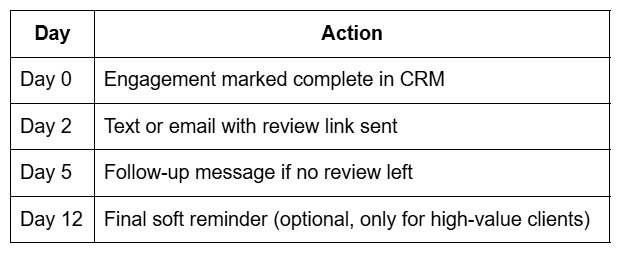
If you are using GoHighLevel or a similar marketing automation platform, this whole sequence can be set up in a few hours, and then it runs forever. Every client who finishes an engagement with you gets asked. Consistently. Without you lifting a finger.
This is exactly the kind of system Progeektech builds for accounting firms as part of their proprietary marketing automation, because the difference between firms that grow and firms that stay flat is almost always about systems, not effort.
Week 4: Respond, Repurpose, and Track
Getting the reviews is only the first part. What you do with them matters just as much.
Respond to every review, good or bad. Google rewards profile activity. When you respond to reviews, it signals to the algorithm that your profile is active and managed. For negative reviews, a calm, professional response shows potential clients that you handle problems like an adult. According to Harvard Business Review research, businesses that respond to reviews see an average 0.12-star increase in their ratings over time and a measurable uptick in new reviews after responding.
Repurpose your best reviews. Copy a few of your five-star reviews and use them as
- Social proof on your website's homepage or services pages
- Content in your email newsletter ("Here is what a client said this week")
- Caption text for LinkedIn posts
- Quoted testimonials in your Google Ads if you run them
Track weekly. Every Monday, check three numbers: total review count, average star rating, and date of most recent review. That's it. If those three numbers are moving in the right direction, your system is working.
What a Good Review Strategy for Accounting Firms Actually Looks Like at Scale
Let me give you a realistic picture of what happens when this is running well.
A firm with 10 active clients completing engagements per month, with a 30% review conversion rate (which is conservative once automation is in place), will collect around 3 new reviews every month. That's 36 new reviews per year. A firm that started the year with 8 reviews would finish with 44.
More importantly, those reviews come in consistently throughout the year, which is what Google's algorithm actually rewards. A flood of 20 reviews in January, followed by nothing for 11 months, is a red flag to the algorithm. A steady trickle of 3 to 5 per month is what builds and holds local rankings.
That review velocity, combined with a complete Google Business Profile and a well-structured website, is the combination that gets accounting firms into the local 3-pack for searches like "CPA in [city]" or "tax accountant near me." And once you are in that 3-pack, the inbound calls change. You stop chasing clients and start choosing them.
The Retention Piece Nobody Talks About
Here's something most marketing content leaves out: asking for reviews also improves client retention.
When you ask a client to reflect on their experience with you, you are prompting them to articulate why they value your work. That moment of reflection strengthens their connection to you. It is the same psychological principle behind why exit surveys at hotels often make people feel better about their stay, not worse.
Research from the Journal of Marketing found that customers who were asked to reflect on positive service experiences showed higher repurchase intent and lower price sensitivity. For an accounting firm, that means clients who leave you a review are less likely to leave you for a competitor offering a lower price.
So the review system is not just a marketing tool. It is also a retention tool. A client who has publicly said nice things about you on Google is a client who has publicly committed to the relationship.
Common Mistakes to Avoid
A few things that will undermine your whole system:
Asking too many people at once. If 15 reviews land on your profile in a single week after years of inactivity, Google may filter them out as suspicious. Spread your requests over time, which is another reason the automated drip sequence works better than a mass blast.
Using incentives. Do not offer discounts, gift cards, or anything of value in exchange for reviews. Google's policies prohibit this, and it can result in review removals or a profile penalty.
Ignoring your review responses. A profile with 50 reviews and zero owner responses looks abandoned. Respond to everything, even a simple "Thank you so much; it was a pleasure working with you."
Asking at the wrong time. Do not ask during tax season when everyone is stressed. Do not ask right after sending an invoice. Ask right after delivering value, when the client feels good.
Your Review Strategy for Accounting Firms Starts This Week
You do not need a big budget to do this. You need 30 days of focused setup and a system that runs after that.
If you put this in place properly, you will see your Google profile move. You will show up for searches you are not showing up for right now. And you will win clients who would have gone to the firm down the street, simply because you have the social proof and they do not.
This is what we mean by a review strategy for accounting firms that actually connects to business outcomes: more rankings, more conversions, and more retained clients. Not just more stars.
Conclusion: Build the System Once, Benefit for Years
Reviews are compounding. Every one you collect today will still be working for you in two years. Every positive response you write adds to your profile's authority. Every new client who finds you through Google and becomes a loyal client is partly the result of the review system you put in place today.
The firms that win local search over the next few years are not going to be the ones with the biggest ad budgets. They are going to be the ones with the best reputation infrastructure, the most consistent review flow, and the clearest social proof.
You already do great work. It is time your online presence reflected that.
Ready to build your review and reputation system from scratch? Progeektech helps accounting firms and CPAs set up fully automated marketing systems that collect reviews, rank on Google, and convert more website visitors into booked appointments. Schedule your FREE discovery call right now → https://www.progeektech.com/1on1-strategy, and we will show you exactly what your growth roadmap looks like.