


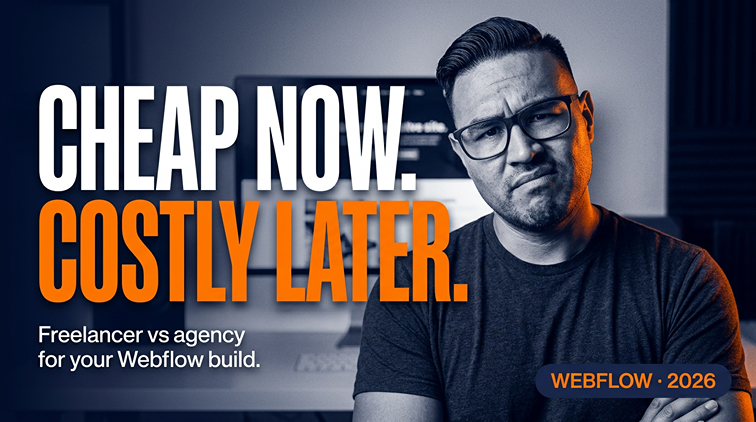
You need a new website or a redesign of the one that's quietly losing you leads. You open a search bar and type "Webflow designer near me" or "best Webflow agency," and within ten minutes, you have thirty tabs open, a dozen portfolios, and zero clarity.
This is one of those decisions that feels small until it isn't. Pick wrong, and you're not just out a few thousand dollars; you're out three months of momentum you didn't have to lose. So let's walk through this together, the way we'd talk it through if you called us up and asked.
The Real Problem: It's Not Freelancer vs Agency, It's Fit vs Mismatch
Here's the thing nobody tells you upfront: there's no universally "better" option between a freelancer and an agency. A freelancer isn't cheap and risky by default, and an agency isn't expensive and bloated by default. What actually determines whether you're happy six months from now is whether the model matches your project's complexity, your timeline, and how much hand-holding you're willing to do yourself.
Recent industry data backs this assertion up. Freelancers tend to win on single, well-scoped projects under about $15,000 with a tight timeline, while agencies pull ahead once you need cross-disciplinary work like strategy, SEO, and design and development moving together at the same time. And the cost gap is real: a six-project monthly workload might run around $6,000 with a freelancer versus $8,000 to $20,000 for the same scope through an agency, delivered faster and with more redundancy built in.
For Webflow specifically, this decision carries extra weight because Webflow isn't just a website builder; it's a design and development environment with its own logic (CMS collections, interactions, class-based styling) that takes real time to master. A freelancer who's "pretty good with websites" is not the same as someone who lives inside Webflow every day.
Why Getting This Wrong Costs You More Than Money
Let's agitate the issue a little, because you deserve the honest version, not the polished one.
If you hire the wrong freelancer, here's what tends to happen: they're brilliant at layout but shaky on CMS structure, so your blog or product pages become a mess six months in. Or they disappear mid-project because they took on three other clients. Or the site launches, looks fine, and then converts nobody because nobody thought about the marketing and conversion side at all. Web design covers a wide range of skills, from visual design to standardized code to search engine visibility, and it's genuinely rare to find one person who's world-class at all of it.
If you hire the wrong agency, the failure mode looks different. You get a beautiful site delivered in Figma comps, a big invoice, and then a handoff document that leaves you fending for yourself the moment the project wraps. Or worse, you're working with a generalist agency that treats Webflow as "just another CMS" instead of a platform with its own best practices for speed, SEO, and scalability.
Either way, the cost isn't only the invoice. It's the rebuild you'll pay for in a year. It's the leads that bounced off a slow, confusing site while you were figuring out who to trust.
What You're Actually Buying: Freelancers vs. Webflow Experts at an Agency
Hiring a Freelancer
A freelancer means one person, direct communication, and usually lower hourly costs. Freelancer rates for design and development work typically fall somewhere between $50 and $200 an hour, depending on experience level, with senior US-based freelancers landing closer to $90 to $150 for specialized Webflow work.
What you get: speed, flexibility, and a direct line to the person actually doing the work. No account manager standing between you and your builder.
What you don't get: redundancy. If your freelancer gets sick, takes a vacation, or simply moves on to a bigger client, your project stalls. You also become the accidental project manager, coordinating design, copy, SEO, and launch logistics yourself, because there's no one else on the team to catch what falls through the cracks.
Hiring Webflow Experts at an Agency
An agency, or a specialized Webflow shop like ProGeekTech, gives you a team: designers, developers, and often a strategist who thinks about conversion and SEO from day one, not as an afterthought. Agency project fees for a marketing site typically land in the $15,000 to $80,000 range, depending on scope, and monthly retainers for ongoing work usually run $3,000 to $15,000.
That's a higher number on paper. But you're paying for something a solo freelancer structurally cannot offer: a built-in system. When ProGeekTech builds a Webflow site, it's not a one-off deliverable; it's connected to a proprietary marketing system designed to keep generating leads after launch, not just look good on day one.
This is really where that question gets decided. If your website is a brochure you'll rarely touch again, a freelancer covers it. If your website is meant to be your primary sales channel, the kind of thing that needs to keep converting, keep ranking, and keep evolving as your business grows, you want a team of Webflow experts who treat the build as infrastructure, not a one-time project.
A Straightforward Decision Framework
Instead of a generic pros and cons list, run your project through these four questions. Be honest with your answers, because the honest answer is usually already sitting somewhere in your gut.
1. How complex is the build? A simple three-page site with no CMS, no automations, and no integrations: freelancer territory. A site with blog collections, gated resources, CRM integrations, or membership logic: you want Webflow experts with agency-level processes behind them.
2. What's your timeline tolerance? An agency can typically kick off within a couple of days and deliver a full build in six to sixteen weeks, depending on scope. Freelancers can move faster on small projects, but sourcing and vetting a good one takes one to three weeks on average, and capacity issues can quietly stretch your timeline without warning.
3. Who's going to manage the project? If you have the bandwidth (and honestly, the patience) to coordinate design feedback, copywriting, SEO, and QA yourself, a freelancer can work well. If you'd rather hand it off and get updates instead of tasks, an agency structure fits better.
4. What happens after launch? This is the one people forget. Many freelancers move on once the invoice clears, which means if something breaks four months later, you're back to square one, hunting for help. Agencies, especially ones built around retainers, are set up to keep supporting, optimizing, and updating the site as your business changes.
Matching the Model to Your Business Type
SaaS companies and startups: Early stage, pre-seed to seed, a freelancer can get an MVP landing page live fast and cheap. Once you're past that first traction milestone and your site needs to support demo bookings, integrations, and a growing content engine, that's when a dedicated Webflow team on the agency side starts paying for itself.
Accountants and accounting firms: Trust and credibility carry enormous weight here, and a website that looks amateurish undercuts every other marketing effort you make. Firms in this category tend to do better with a partner who understands both Webflow and conversion-focused copy, since the site isn't just a portfolio; it's often the first (and sometimes only) impression a prospective client gets before they call.
Local small businesses: If your needs are simple (hours, services, contact form, maybe a booking widget), a well-briefed freelancer might be all you need. But if local SEO and lead capture actually drive your revenue, the ROI math tends to favor a team that treats search engine optimization and Webflow build quality as one connected system rather than two separate line items.
Red Flags Either Way
Whichever direction you lean, a few warning signs apply no matter who you hire:
- No clear contract covering scope, revisions, payment milestones, and who owns the final files
- Vague answers when you ask how they handle Core Web Vitals, mobile performance, or accessibility standards
- No post-launch plan, meaning you're on your own the day the site goes live
- The portfolio is heavy on visuals and light on any mention of results, traffic, or conversion outcomes
A Quick Real-World Pattern We See
We've worked with SaaS founders who came to us after a freelancer built them a gorgeous site that had zero SEO structure underneath it, no clean CMS setup, no schema, nothing. It looked stunning in a demo and did almost nothing in Google. That's not a knock on freelancers in general; it's a reminder that "can build in Webflow" and "can build a Webflow site that ranks and converts" are two different skill sets, and it's worth asking directly which one you're hiring for.
Frequently Asked Questions
Is a freelancer or an agency cheaper for a Webflow project?
A freelancer is usually cheaper on a per-project basis, often in the low thousands for a simple site, while an agency build typically starts higher. But factor in your time spent managing the project and the cost of a rebuild if the freelancer's build lacks proper SEO structure, and the gap often narrows.
How long does a Webflow project take with each option?
Freelancers can move quickly on small, well-scoped sites, sometimes just a few weeks, but sourcing a good one can add one to three weeks upfront. Agencies typically run six to sixteen weeks for a full build, factoring in discovery, design, development, and QA.
Can a freelancer handle SEO for my Webflow site?
Some can, but SEO for Webflow specifically requires understanding CMS structure, page speed, and technical setup on top of general SEO knowledge. Please inquire with any freelancer directly about their SEO process to ensure it meets your needs.
What happens if I need ongoing changes after launch?
The answer depends entirely on your agreement. It’s important to have support terms in writing, as freelancers may have varying availability after launch. Agencies working on retainers are typically built for this exact need, with ongoing updates, optimization, and support baked into the relationship.
The Bottom Line
There's no wrong answer between a freelancer and an agency, only a mismatch between your business stage and the model you pick. If your project is small and well-defined and you have the time to manage it, a freelancer can absolutely get the job done. But once your website needs to generate leads, support SEO, and convert visitors into booked calls, working with a partner who builds the site as part of a bigger marketing system starts to make a measurable difference.
If you're still not sure which path fits your project, we'll tell you straight, no upsell required. Book a free strategy session with ProGeekTech and let's figure out, together, exactly what your Webflow project actually needs.