


You already know social media matters. What nobody tells you is that trying to show up everywhere is the fastest way to burn out your team and still miss your growth targets.
Here's the thing most business owners get wrong: they pick platforms because a friend uses them, or because a competitor posts there, or because it "feels" like the right move. That's a guess dressed up as a strategy, and guesses cost money. A local marketing consultant who's run campaigns across dozens of industries will tell you the same thing: the businesses that win on social media aren't the ones posting the most. They're the ones posting on the right platforms, consistently, with content built for how people actually use each one.
This post breaks down the five platforms worth your time in 2026, why each one earns its spot, and how to decide which ones fit your business instead of copying someone else's playbook.
The Problem: You Can't Be Everywhere, So Stop Trying
There are dozens of social platforms out there, and new ones show up every year. If you're a SaaS founder, an accounting firm owner, or a local service business, you don't have the bandwidth to run all of them well. You have a business to run.
Here's a number that should change how you think about this: TikTok posts see an average organic engagement rate of 5.69 percent, while Instagram business accounts average between 0.50 and 1.0 percent, and Facebook pages average between 0.07 and 0.15 percent. That's not a small gap. Posting on the wrong platform for your audience means you could be working ten times harder for a fraction of the results.
The Agitation: What Spreading Yourself Thin Actually Costs You
Picking too many platforms, or the wrong ones, doesn't just waste time. It shows up in your numbers.
- Inconsistent posting. When you're managing five accounts with no clear priority, something always slips.
- Content that fits nowhere. A LinkedIn-style caption doesn't land on TikTok, and a TikTok-style video feels out of place on LinkedIn. Trying to reuse the same content everywhere makes it weaker on every platform.
- Missed revenue. Customers who engage with a business on social media spend 35 to 40 percent more on that brand's products and services, and 76 percent of consumers who have a good social media experience with a brand are likely to recommend it to others. When your presence is thin or inconsistent, you're leaving that money on the table.
- Algorithm penalties for inactivity. Platforms reward accounts that post consistently and punish the ones that go quiet. A half-hearted account can hurt you more than no account at all.
This is exactly the kind of problem a local marketing consultant gets called in to fix: not "we need more platforms," but "we need the right three or four, done properly."
The Solution: Pick Platforms Based on Where Your Buyers Actually Are
Before you pick a single platform, answer this question honestly: where does your ideal customer already spend time online, and what are they doing there? A local marketing consultant will usually start with your customer, not with the platform. Once you know that, the list below gets a lot easier to use.
1. Facebook: Still the Safest Bet for Local and Service Businesses
Facebook isn't flashy anymore, but it's not going anywhere either. Facebook is still the world's largest social media platform with more than 3.07 billion monthly active users. If your customers are adults 25 and up, especially in your local area, this is still where a huge chunk of them are checking reviews, joining community groups, and finding businesses like yours.
Ideal for: local small businesses, home services, restaurants, and any business that depends on trust and reviews within the community. Customer photos, event promotion, quick updates, and Facebook groups for community building.
Posting Frequency: 2-4 posts a week, taking about 2-3 hours a week, including community replies.
2. Instagram: The Visual Front Door for Younger, Local, and Service-Based Audiences
Instagram works when your product or service can be shown, not just described. 73 percent of U.S. small businesses say they use Instagram to engage with customers weekly, and 77 percent of small businesses say they prefer Instagram for customer engagement.
Best for: Local businesses with a visual product, CPA firms wanting to look approachable, and SaaS companies showing their product in action.
Types of content that work: Reels, before-and-after content, behind-the-scenes clips, and quick tips.
Time commitment: 3-5 posts a week + daily Stories, around 3-5 hours a week.
3. LinkedIn: Non-Negotiable for B2B, SaaS, and Accounting Firms
If your customers are other businesses, this is where the deals actually get influenced, even if they close somewhere else. 85 percent of B2B marketers name LinkedIn their highest-performing channel, and LinkedIn company posts average between 2 and 5 percent engagement with strong content.
Best for: SaaS companies, accountants and accounting firms, consultants, and anyone selling to decision-makers.
Working content: Founder posts, client wins, industry commentary, and short educational carousels.
Time commitment: 2-3 posts per week, about 2-4 hours per week for posting and engagement.
4. TikTok: The Highest-Engagement Platform, If You're Willing to Show Up on Camera
You don't need to dance. You need to be useful, fast, and a little bit human. 33 percent of small businesses now use TikTok, up from 17 percent in 2023. That growth isn't an accident; it's because short-form video is where attention is going.
Best for businesses that can teach something quickly, show a process, or have a personality worth watching, from local restaurants to SaaS explainer content.
Content that works: Quick tips, “day in the life,” myth-busting your industry, and simple how-tos shot on a phone.
Time commitment: 2-4 videos per week, 3-6 hours per week, including edits.
5. Nextdoor: The Overlooked Platform Every Local Business Should Test
This one gets skipped constantly, and that's exactly why it works. Nextdoor is built entirely around neighborhoods, so when a local marketing consultant is building a plan for a small business, this platform usually makes the shortlist before Twitter or Pinterest ever comes up. 90 percent of local businesses use social media as part of their marketing strategy, and 78 percent of them rely on social media to help drive revenue. Nextdoor captures that same local intent with far less competition for attention than Facebook or Instagram.
Best for: Home services, local retail, restaurants, medical and dental practices, and anyone whose customers live within a few miles.
Content that works: Local recommendations, community involvement posts, and direct answers to neighborhood questions.
Time investment: 1 to 2 posts a week, about 1 to 2 hours weekly.
A Simple Framework for Choosing Your Platforms
You don't need all five. Most businesses do best focusing on three. Here's a quick way to narrow it down: the same approach a local marketing consultant would walk you through in a strategy session:
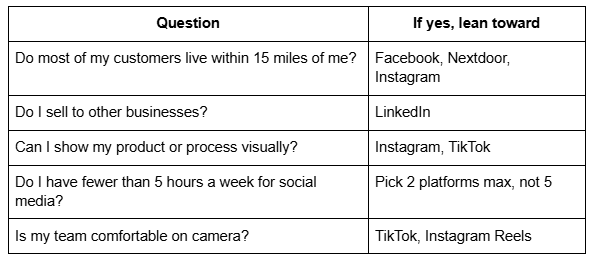
Fill this table out honestly before you commit to a platform. If you're not sure how your customers actually search for businesses like yours, that's worth finding out before you build a content calendar around a guess.
Frequently Asked Questions
How many social media platforms should a small business actually use?
Most small businesses do better with three focused platforms than five scattered ones. Pick the platforms where your customers already spend time, and get those right before adding more.
Do I need to be on social media if I already rank well on Google?
Search and social do different jobs. Search catches people actively looking for you, while social builds familiarity before they ever search. More than 60 percent of product discovery occurs on social platforms like TikTok, Instagram, and YouTube, beating out Google. Skipping social means skipping a big chunk of how people find businesses now.
How much should a small business budget for social media each month?
This varies a lot by industry and goals, so treat any number here as a starting point, not a rule. Many small businesses start with 5 to 10 hours of team time a week, plus a modest paid boost budget, then adjust based on which platform actually produces leads.
What's the difference between hiring a local marketing consultant and doing social media myself?
Doing it yourself works if you have the time and want to learn as you go. A local marketing consultant brings a tested process, saves you the trial and error, and usually pays for themselves by helping you avoid wasted ad spend and picking the right platforms from day one.
Wrapping It Up
Being on every platform isn't a strategy; it's a distraction. Pick the two or three platforms where your actual customers spend their time, show up consistently, and give each one content built for how people use it. That's the whole game.
If you're not sure where to start or you want a second opinion on your current platform mix, a local marketing consultant can walk through your customer base with you and build a plan that fits your time and budget instead of a generic checklist. Schedule a free growth audit with Progeektech and get a clear answer on which platforms deserve your attention this quarter.
More Reads From the Progeektech Blog
- How Do I Know Which Marketing Is Actually Booking Calls? (Attribution Made Simple)
- How Do Bookkeepers Get Their First 10 Clients in 2026?
- How Do You Respond to a Bad Google Review? (Templates for Service Businesses)